Stop 80 of 109 · Two Minute Hands
1852 · Bristol, Corn Exchange
The Clock with Two Minute Hands, Ten Minutes Apart
When railways demanded one national time, the clock on Bristol's Corn Exchange grew a second minute hand rather than give up its own.
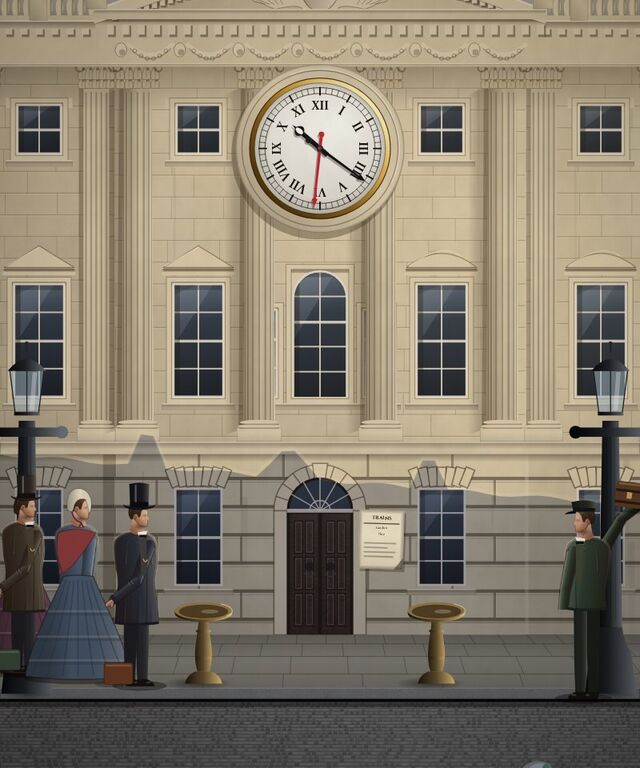
Look closely at the clock on the front of Bristol's Corn Exchange, installed in 1822, and you'll notice something odd: two minute hands, pointing to slightly different times. One tracks Bristol's own local time, set by the sun overhead. The other, about ten minutes ahead, shows London time, the time London's railways ran on.
The gap is not an error. Bristol sits roughly two and a half degrees of longitude west of Greenwich, and since the sun takes about four minutes to cross each degree, noon arrives in Bristol some ten minutes after it does in London. Every town to England's west had its own honest, sun-based time, all of them slightly different, and that worked fine until trains started running on schedules.
Railways couldn't operate on dozens of local times, so from 1840 the Great Western Railway ran its trains on London time regardless of where they were. Passengers, though, still set their pocket watches by the town clock, hence the second hand, added so Bristol's clock could show both times at once and travellers could adjust before their train left.
The compromise didn't last many decades. Britain made Greenwich time the legal standard nationwide in 1880, and local time quietly disappeared. But the two-handed clock on Corn Street still keeps both, a small monument to the years when the railway timetable and the sundial disagreed.