Stop 58 of 109 · Wind Once a Year
1676 · Greenwich, Royal Observatory
Two Clocks That Proved the Earth Keeps Time
At the brand-new Royal Observatory, a pair of clocks wound only once a year helped prove that the spinning Earth itself could be trusted as a timekeeper.
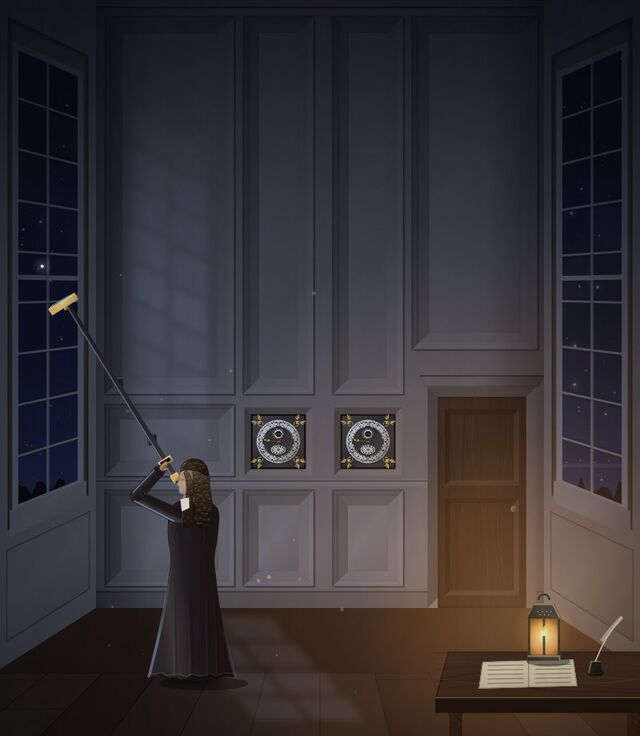
When Christopher Wren's Royal Observatory opened at Greenwich in 1676, its Octagon Room held two clocks unlike any before them. Built by Thomas Tompion, each ran a full year on a single winding, driven by heavy weights and regulated by pendulums thirteen feet long, too tall to fit in any case, so they swung inside the wall itself, hidden above the dials.
The clocks weren't there simply to tell the hour. The astronomer John Flamsteed used them alongside a fixed telescope to time the star Sirius crossing his sightline, night after night. If the clocks were accurate, the star should cross a little earlier each night, by a predictable few minutes, as the Earth completed its spin slightly faster than a full solar day.
It did, night after night, and the conclusion mattered well beyond Greenwich: the Earth turns at a steady, trustworthy rate, so the stars themselves could be read like a clock face. That confidence underwrote celestial navigation for the next two centuries.
The hill where Flamsteed worked gave its name to something every traveler still recognizes: Greenwich Mean Time, and the GMT marked on a dual-time watch, honoring the same idea a slightly odd pair of year-long clocks first helped to prove.