Stop 95 of 109 · Magnets vs. Watches
1956 · Geneva, CERN
The Cage That Kept Time Steady Near a Giant Magnet
In the 1950s, watches near powerful physics-lab magnets ran wild, until a simple iron shield learned to steer the field around them.
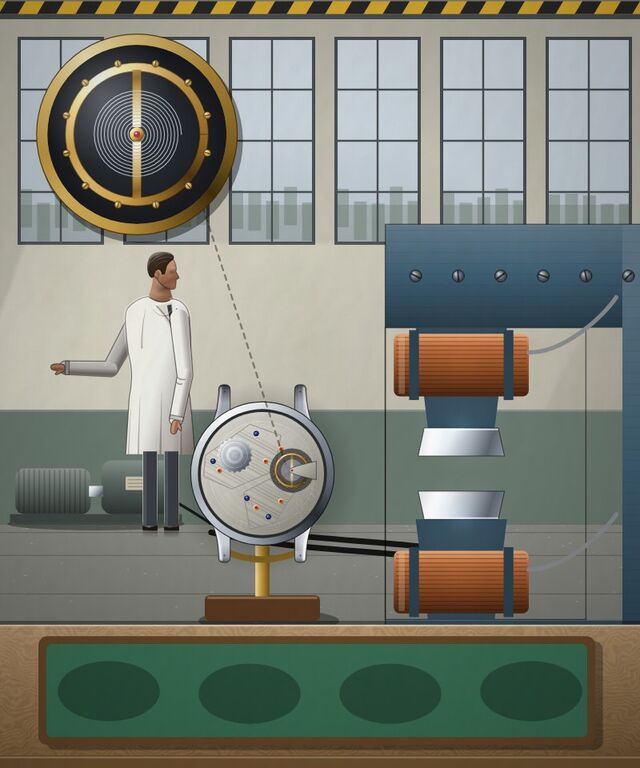
CERN was founded outside Geneva in 1954, and its first accelerator, the Synchrocyclotron, gave its first beam in August 1957. Strong magnets, it turned out, were bad news for wristwatches.
A watch's steel hairspring is a fine coiled wire, and a powerful magnetic field can make its coils cling together, shortening and stiffening the spring so that it snaps back faster. That makes the balance wheel, the small wheel that normally ticks back and forth at a steady rate to keep the watch's pace, swing too fast, and the watch runs fast (sometimes it just stops instead).
The fix, developed through the 1940s and 50s, was an inner case of soft iron wrapped around the movement: not blocking the magnetism so much as gathering it and leading it harmlessly around the works. Pilots' watches like the RAF's Mark 11 had one by 1948; so did IWC's 1955 Ingenieur and Rolex's 1956 Milgauss, rated to 1,000 gauss, a unit of magnetic field strength, and popular with scientists working at CERN.
One common name for this shield, a "Faraday cage," isn't quite accurate: a true Faraday cage blocks electric fields, not a steady magnetic one, which needs a different, highly permeable metal to redirect it. Claims that this or that watch was the "first" antimagnetic model, going back to the nineteenth century, use an entirely different method and remain disputed. What isn't disputed is the fix itself: that same soft-iron shield, gathering the field instead of blocking it, is still how most antimagnetic mechanical watches work today.