Stop 94 of 109 · Two Times at Once
1955 · New York, Transatlantic flights
Two Clocks on One Wrist, Five Time Zones Apart
Airline crews flying New York to London in the 1950s needed home time and local time at a glance, so a fourth hand and a two-colour bezel gave it to them.
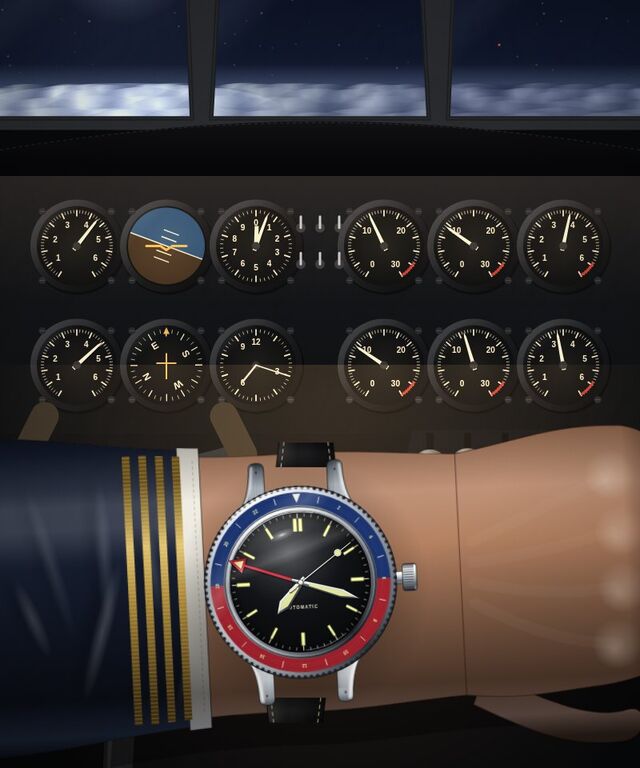
By 1955, airline crews were flying piston airliners like Pan Am's DC-7B across the Atlantic, five hours of clocks between New York and London, with jets still a few years off.
Rolex, working with Pan Am for its crews, launched a watch built for exactly that problem: a fourth hand that circled the dial once every 24 hours, paired with a rotating bezel marked in two colours for day and night. Keep the ordinary hands on home time, turn the bezel by the number of hours to the other city, and the 24-hour hand tells you what time it is there.
The original 1955 version linked that fourth hand directly to the hour hand, so a pilot still read the second time zone off the bezel rather than off the dial itself; an hour hand you could set independently, letting the dial show local time directly, only arrived in the 1980s. The bezel's bakelite insert, with its luminous red-for-day and blue-for-night numerals, made the whole thing readable at a glance in a dim cockpit.
Other watchmakers had built 24-hour watches before; this one is remembered not for being first, but because the fix it popularized, a fourth hand plus a rotating two-colour bezel, is still exactly how most GMT watches read a second time zone today.