Stop 93 of 109 · Set the Bezel
1953 · Toulon, French Navy
Set It Once, Trust It All the Way Down
France's first combat divers needed a watch that could not lie about how long they had been under, so its bezel could only ever turn one way.
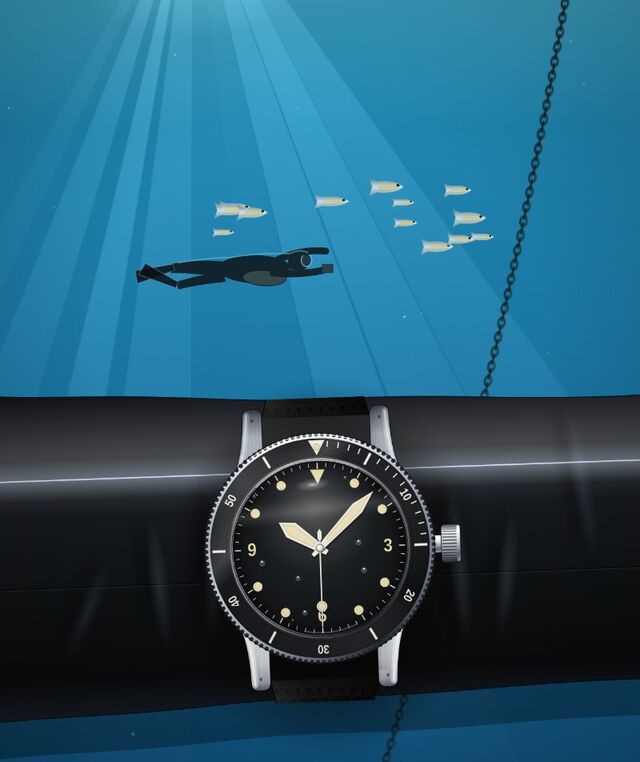
In the early 1950s, France's navy formed its first combat-diver units. In 1953, two of the officers setting up Commando Hubert, based at Saint-Mandrier near Toulon, drew up a wish list for a watch: big luminous numerals on a black dial, resistance to magnetism, real water-tightness, and a bezel that could time a dive.
Blancpain, whose co-director Jean-Jacques Fiechter was himself a diver, built it: the Fifty Fathoms, dated by the maker to 1953 (some collectors argue deliveries actually began in 1954 or 1955). The idea was simple: set the bezel's zero mark to the minute hand just before descending, and for the rest of the dive, the minute hand reads elapsed time straight off the ring.
The very first Fifty Fathoms bezel didn't ratchet one way, as most dive bezels do today. It simply locked in place, needing a firm push to turn it at all, so an accidental knock couldn't move it. The now-familiar one-way bezel, which can only ever show more time used, never less, came as a refinement afterward. Either way, the logic is the same: better to think you have less air left than you do, and surface early, than the other way around.
Fifty fathoms works out to about 91 metres.