Stop 16 of 109 · Stop the Water
c. 400 BCE · Athens, Greece
The Jar That Timed a Trial
In Athenian law courts, a speaker's allotted time ran out not with a bell, but as water quietly drained from a clay jar.
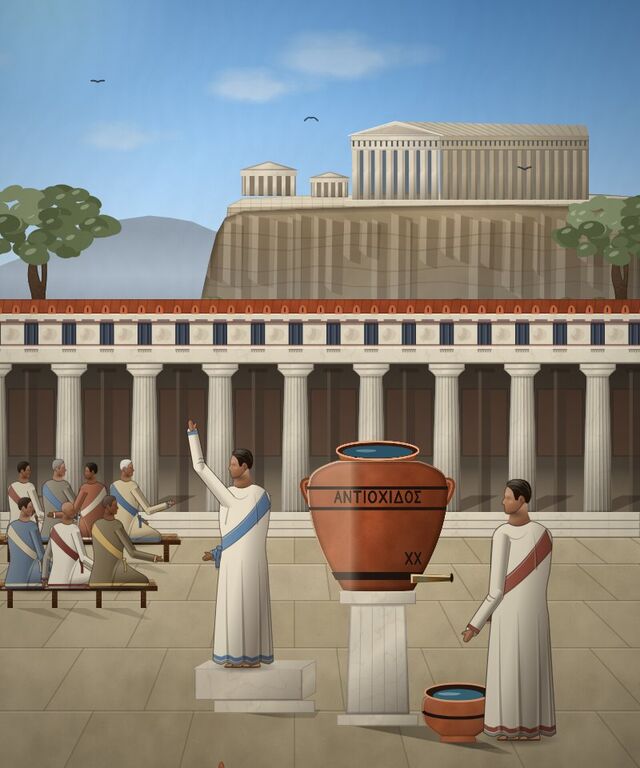
In the law courts of Athens, around 400 BCE, a speaker's time was measured by the klepsydra, literally the "water thief": a clay vessel with a bronze tube fitted near its base. One example recovered from the Athenian Agora holds about 6.4 litres of water and drains through its tube in roughly six minutes. More serious cases were allotted more water, and therefore more time to speak.
The system had a built-in fairness rule, recorded in the ancient handbook known as the Constitution of the Athenians: whenever a law had to be read aloud during a speech, an official covered the tube by hand, stopping the flow, so that reading the law itself never ate into the speaker's own time.
There was one deliberate exception. In the gravest cases, those involving a possible death sentence, exile, or the loss of a person's entire property, the water was never stopped for any reason, not even to read a law into the record. The stakes were considered too serious to interrupt.
The klepsydra made time visibly, communally fair: everyone in the room could watch the same water fall and know exactly how much a speaker had left, the same open, legible promise a chronograph's stopwatch hand still makes today.