Stop 71 of 109 · Five Watches
c. 1800 · Beijing, Qing China
The Alarm Clock Made of Smoke
In Qing-dynasty Beijing, a slow-burning stick of incense could wake a household at exactly the right hour, no gears required.
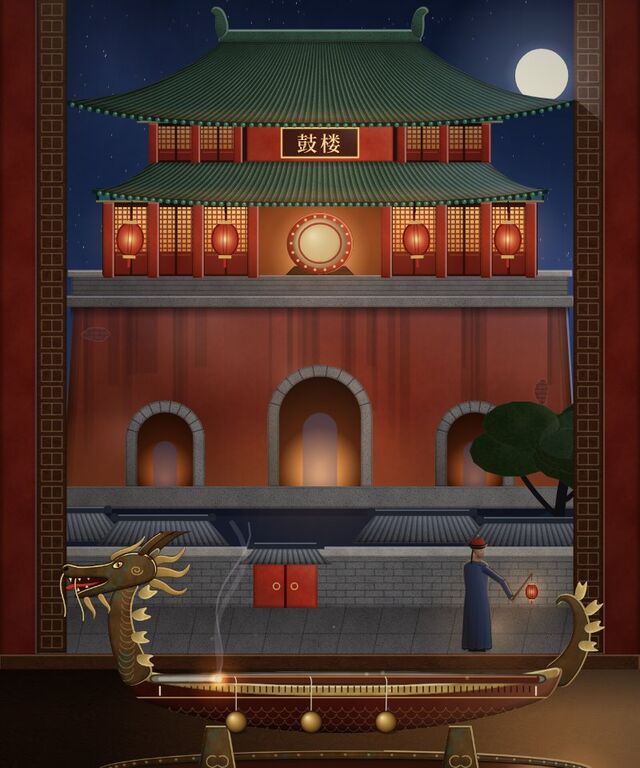
Every night in imperial Beijing, drums sounded from the Drum Tower to mark five watches, or gēng, each lasting two hours and twenty-four minutes, the first beginning at 7:12 in the evening. Inside homes, a different kind of clock kept its own version of the same schedule: an incense “dragon boat,” a long trough holding a slow-burning stick.
Small threads, each carrying a little weight, were tied across the trough at measured intervals. As the incense burned steadily along its length, the ember reached each thread in turn, burning through it, and the weight it held would drop into a metal tray below with an audible clang, a built-in alarm, timed entirely by how far the incense had burned.
Underneath these devices sat a genuinely old unit of time, the kè. For centuries a day was divided into exactly one hundred kè, which works out to 14.4 minutes each, an awkward number. In 1628 the system was reformed to ninety-six kè of exactly fifteen minutes, which is why a kè still corresponds neatly to a quarter hour today.
An incense clock is, at its core, an alarm: a slow and steady process paired with a trigger that fires at just the right moment. A watch's own alarm function, ringing at a chosen hour, or the sweep of a chronograph's stopwatch hand, does the same job today, with a wheel and a hammer instead of smoke and a thread.