Stop 70 of 109 · Nine at Noon
c. 1800 · Edo, Japan
The Clock That Stretched With the Seasons
In old Edo, an hour in summer daylight was a longer hour than one at night, and clockmakers built extraordinary machines to keep up.
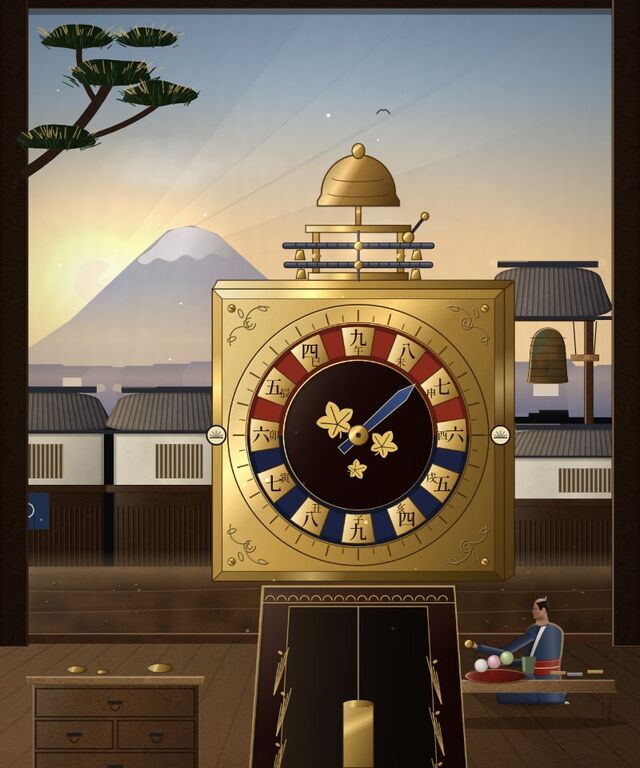
For centuries, Japan divided both day and night into six hours each, called toki, but those hours weren't a fixed length the way ours are. Daylight hours stretched in summer and shrank in winter, and nighttime hours did the opposite, so that day and night always held six hours each no matter the season. To make it stranger still, the hours were counted downward, from nine to four, which meant that both noon and midnight were called “nine.”
Building a clock for a system like that took real ingenuity. Japanese clockmakers designed wadokei, mechanical clocks built specifically to handle these shifting hours, with twin balance wheels, one weighted for the faster pace of winter nights and one for slower summer nights, along with hour plates that could be physically slid along the dial to match each season's changing hour lengths.
One hour in particular left an unexpected trace in the Japanese language. The afternoon hour called yatsu, the “eighth,” fell roughly between two and four in the afternoon and became a customary time for a small meal. Add the polite prefix o- and you get oyatsu, the everyday word for snack still used in Japan long after the clocks that named it fell out of use.
Japan adopted the fixed, Western-style hour in 1873, retiring these ingenious sliding clocks for good. But the snack survived the clock that named it.