Stop 69 of 109 · Ten Hours a Day
1793 · Paris, French Republic
The Ten-Hour Day That Didn't Survive the Revolution
For a brief stretch of the 1790s, French law required clocks to tell time in tens, ten hours a day, a hundred minutes an hour. It lasted less than two years.
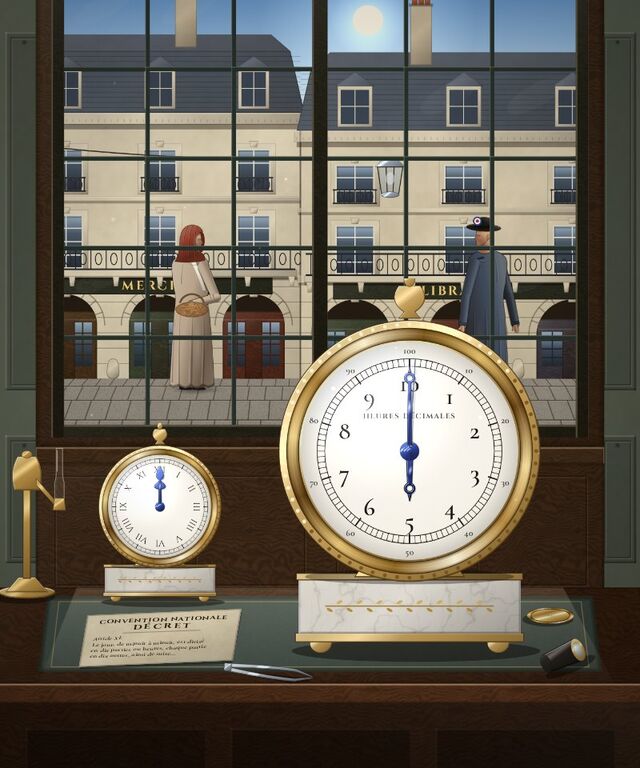
Revolutionary France remade nearly everything by the decade's decimal logic, including the calendar and, for a short and strange stretch, the clock itself. A decree of 1793 divided each day, from midnight to midnight, into ten hours, each hour into a hundred minutes, and each minute into a hundred seconds. Under the new scheme, noon fell at five o'clock and midnight was ten.
The units weren't small tweaks on the familiar ones, either. A decimal hour ran two hours and twenty-four ordinary minutes; a decimal minute lasted about eighty-six ordinary seconds, closer to a minute and a half than to a minute. Clockmakers produced dials that tried to show both systems at once, old hours around the rim and new ones inside.
It never really took hold. The law required decimal time on official documents only starting in September 1794, and the whole scheme was suspended less than a year later, in April 1795. Very few decimal clocks and watches were ever made, and fewer still survive.
The metric system, born in those same revolutionary years, endured and reshaped the world's units of length and mass. Decimal time did not, which is why a watch today still counts twelve hours of sixty minutes each, a numbering system that traces back to ancient Babylon, thousands of years before the French Republic tried, briefly, to improve on it.