Stop 68 of 109 · Drop the Watch
1790 · Paris, Quai de l’Horloge
The Watch That Was Never Supposed to Survive a Fall
Breguet is said to have thrown his own watch onto a ballroom floor to prove a point. The invention behind the stunt was real; the stunt itself may not have been.
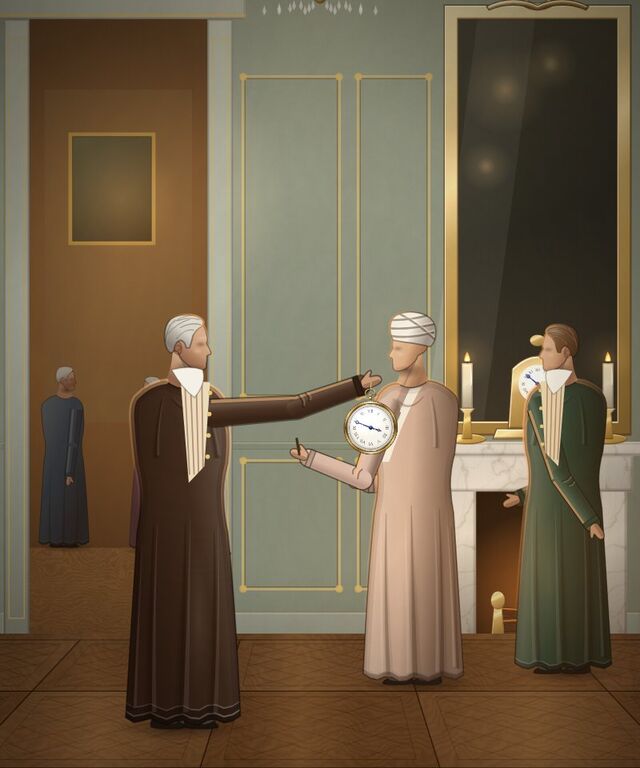
Before the 1790s, dropping a pocket watch was often fatal to it. The balance wheel spins on pivots barely thicker than a hair, and a hard knock would usually snap one, silencing the watch for good. Abraham-Louis Breguet's solution, which he called the pare-chute, was to mount each pivot's tip, shaped like a small cone, inside a tiny cup carried on a delicate spring. A shock pushes the pivot up against a sturdier shoulder that can take the impact, and the spring settles it neatly back into place.
According to Breguet's own house, the inventor once demonstrated his creation at a party at Talleyrand's by simply throwing his watch onto the floor in front of guests, and it kept running. It's a marvelous story, and Breguet's manufacture still tells it. But no written record from that evening survives to confirm it happened as described, and it's best treated as a legend attached to a real invention rather than a documented fact.
The invention itself is not in doubt. Breguet tested the pare-chute around 1790 and had fitted it to all of his self-winding “perpétuelle” watches by 1792, refining the design further for an exhibition in 1806.
Nearly every mechanical watch made today carries some version of shock protection on its balance, a quiet descendant of Breguet's spring-loaded cups. It's the reason a knock against a table doesn't stop a watch dead, whether or not its inventor ever actually threw one on purpose.