Stop 67 of 109 · The Writer
1774 · La Chaux-de-Fonds, Neuchâtel
The Boy Who Wrote With a Program, Not a Mind
In 1774, a mechanical boy dipped a real quill and wrote out any sentence up to forty letters long, using a kind of memory that can genuinely be swapped out.
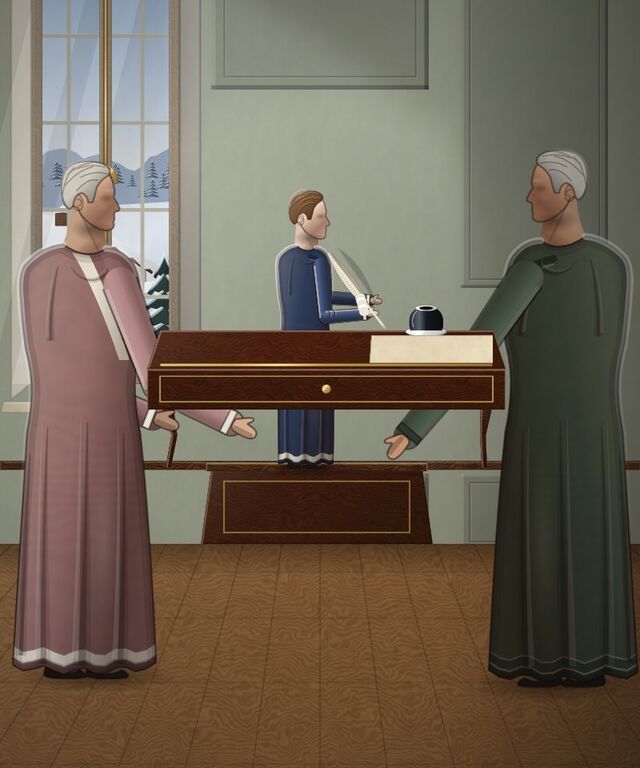
Pierre Jaquet-Droz, his son Henri-Louis, and their collaborator Jean-Frédéric Leschot spent six years, from 1768 to 1774, building three astonishing automata, mechanical figures rigged with gears and cams to move on their own as though alive. The most celebrated, known simply as the Writer, is a small mechanical boy seated at a mahogany desk, made from roughly six thousand parts. He dips a genuine goose-quill pen into ink, shakes off the excess, and writes, his eyes following the words as his hand moves.
What he writes isn't fixed. A wheel carries the chosen text, letter by letter, up to forty characters, and a stack of cams shaped for each letter guides the pen's motion up and down, side to side, and lifts it clear of the paper between strokes. Change the wheel, and the boy writes something new.
That changeable, stored set of instructions is why the Writer is often called an early ancestor of the computer, a reasonable comparison since it follows a genuinely programmable sequence step by step. It's worth being precise about the limits, though: the Writer can't calculate anything, only reproduce the letters he's been set to write, so “ancestor” is closer to the truth than “predecessor.”
All three automata still work today and can be seen at the Musée d'art et d'histoire in Neuchâtel, which acquired them in 1909. Fine watches still use cams much like his, quietly moving hands in chronographs, watches with a built-in stopwatch function, and calendars long after the boy's programmable letters made the trick famous.