Stop 66 of 109 · Our Trusty Friend the Watch
1773 · Tahiti, Cook’s second voyage
Our Trusty Friend the Watch
On his second voyage around the world, Captain Cook leaned on a single chronometer so completely that he gave it a nickname.
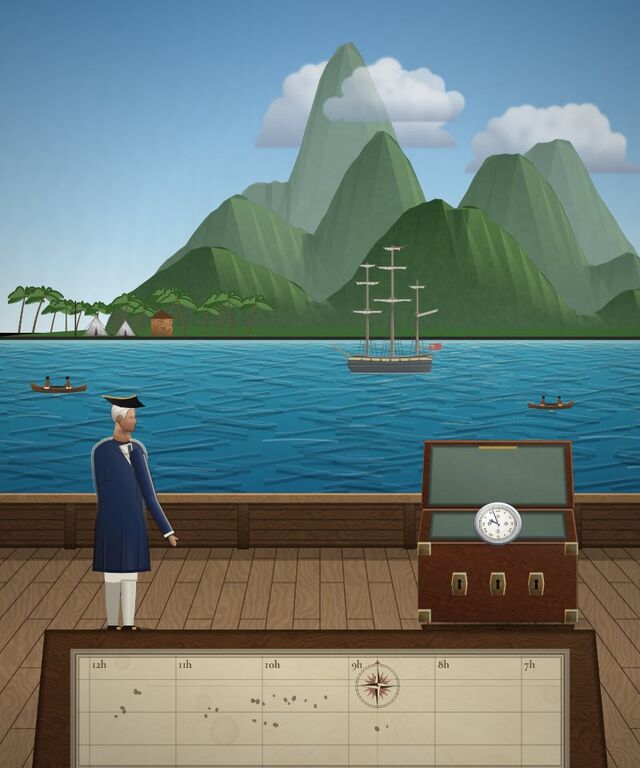
When James Cook set out on his second Pacific voyage in 1772, his ship Resolution carried a watch called K1, a marine chronometer built to keep near-perfect time at sea, a precise copy of John Harrison's H4 built by the instrument maker Larcum Kendall. It traveled locked in a box requiring three separate keys, held by three different officers, and was wound daily, by order, as close to noon as convenient.
In August 1773, Cook anchored at Tahiti, a useful test of the watch's accuracy, since the island's longitude had already been carefully fixed a few years earlier during the 1769 transit of Venus. K1 held its own. Cook came to trust it completely, calling it in his journal “our trusty friend the Watch” and “our never-failing guide,” and reported afterward that it had “exceeded the expectations of its most zealous advocate.”
Every claim here rests on solid ground: Cook's own words survive in his journals, and the watch itself, K1, is preserved today at the Royal Museums Greenwich. There's no legend to untangle, just a captain's genuine gratitude toward a piece of clockwork that let him chart the Pacific with a confidence no navigator before him had enjoyed.
A watch that keeps home time and lets you measure how far you've traveled from it: it's the same principle, largely unchanged, behind every travel watch made since.