Stop 65 of 109 · Find the Ship
1761 · London, The longitude prize
The Watch That Crossed an Ocean and Barely Noticed
John Harrison built a watch precise enough to find a ship's position at sea, but the £20,000 he was promised for it never quite arrived.
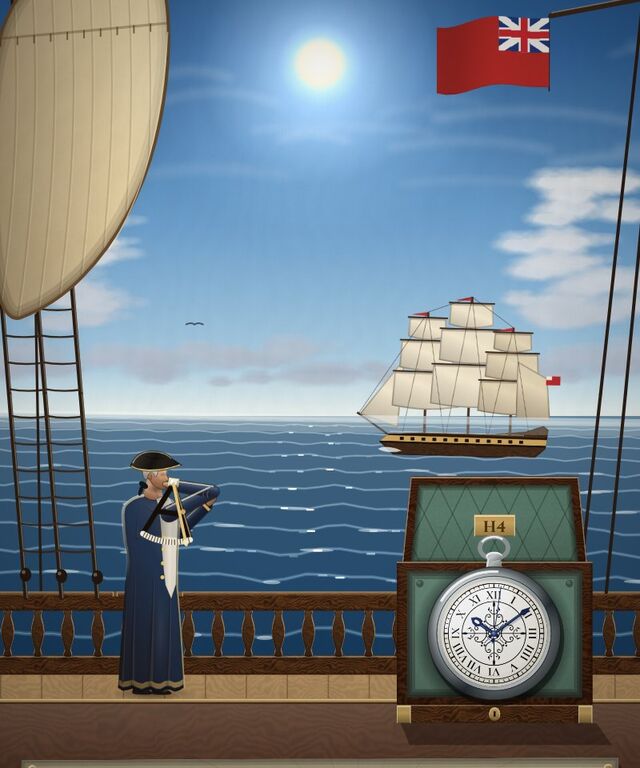
Finding longitude at sea was, for most of the eighteenth century, close to guesswork. The solution John Harrison eventually proved, after decades of work, was startlingly direct: carry an accurate clock set to home time, compare it to local noon determined by the sun, and the difference tells you exactly how far east or west you've traveled, four minutes of difference for every degree of longitude.
His fourth attempt, H4, was tested on a voyage to Jamaica in 1761 and 1762 and came home having lost only about five seconds over roughly two months at sea, far better than the Longitude Act of 1714 had asked for.
The Act had promised up to £20,000 to whoever solved the problem, and popular memory often has Harrison collecting the full prize. He didn't. The Board of Longitude never formally awarded it to him; he was paid in installments only after years of dispute over whether H4's success could be repeated, and Parliament eventually granted him a further sum in 1773, separate from the official prize. It's a case where the invention's success is beyond question even though the story of its reward is often told a little too neatly.
What H4 proved has outlasted the argument over payment. Carrying home time with you as you travel, then reading local time against it, is exactly what a modern GMT or dual-time watch still does.