Stop 64 of 109 · Read the Giant
1734 · Jaipur, Jantar Mantar
The Sundial the Size of a Building
Jaipur's Samrat Yantra is the largest stone sundial ever built, precise enough, its admirers say, to read time to the second, though the shadow itself has other ideas.
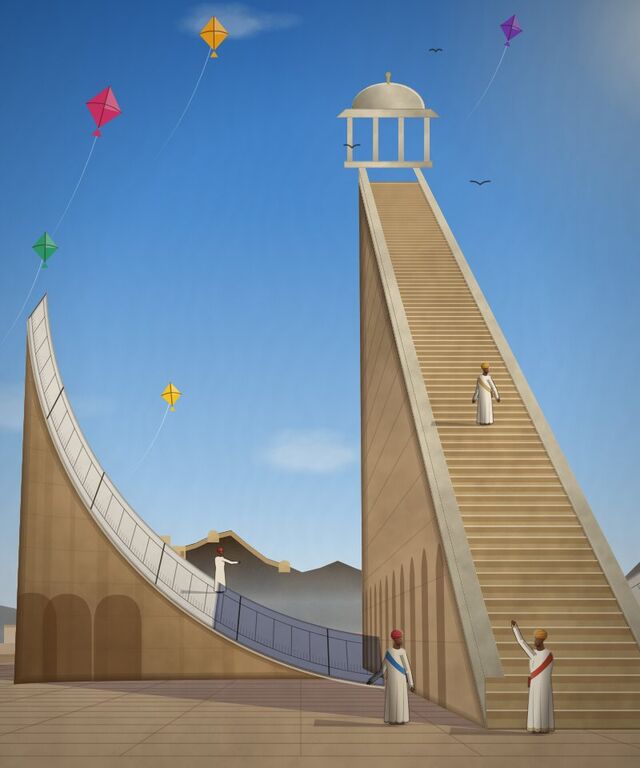
Maharaja Jai Singh II completed his observatory of giant masonry instruments at Jaipur in 1734. Its centerpiece, the Samrat Yantra, is a sundial on an extraordinary scale: a triangular gnomon, the wall whose edge throws a shadow to mark the time, rising twenty-seven meters into the sky, tall enough to need its own staircase, aligned precisely with the Earth's axis.
The idea behind building a sundial this large is simple and rather beautiful: make the dial big enough, and even small movements of time spread out across enough distance to be read finely. The shadow of the Samrat Yantra's edge sweeps across curved marble quadrants at a stately pace of roughly six centimeters a minute, about a hand's breadth.
Those quadrants are marked in divisions as fine as two seconds, which has led to a striking claim: that the instrument can tell time to within two seconds. It's a debated point. The shadow's edge isn't perfectly sharp; it's a soft penumbra rather than a crisp line, and exactly where to read it varies from one observer to the next. What's beyond dispute is the shadow's steady creep of about six centimeters every minute.
It's the same instinct that drives fine watchmaking centuries later: a longer minute hand and a more finely divided dial let a wearer read time more precisely, for exactly the reason Jai Singh's astronomers understood when they raised a sundial the size of a building.