Stop 63 of 109 · Brass Against Steel
c. 1726 · Barrow upon Humber, Lincolnshire
Nine Rods, Two Metals, One Steady Beat
A Lincolnshire carpenter who once built clocks entirely out of wood found a way to cancel out the effects of heat using nothing but brass and steel.
John Harrison started out making clocks the way a carpenter would: his first, in 1713, was built almost entirely of wood, with oak wheels and lubrication-free boxwood axles. Three of these wooden clocks still survive. But by the 1720s he had turned to a harder problem: temperature.
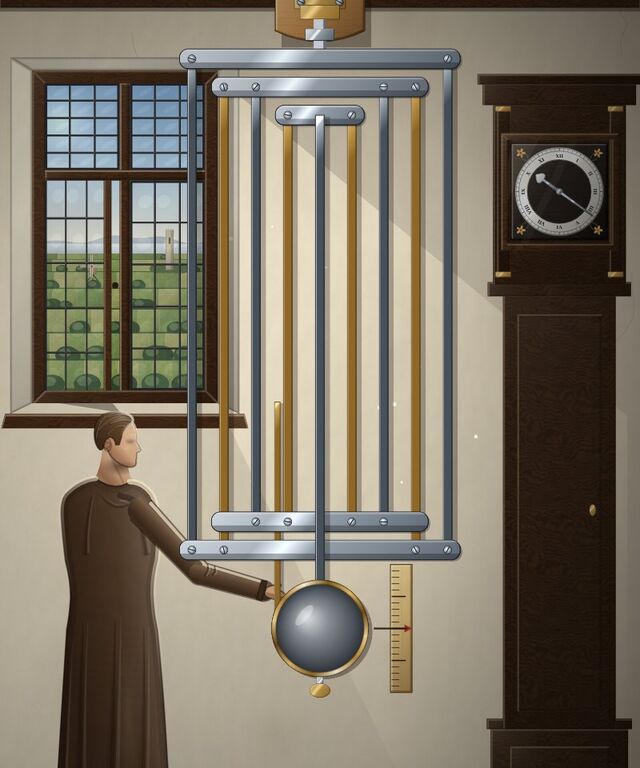
A pendulum's rod grows longer in the heat, slowing the clock down, and Harrison's answer, developed around 1726 near his home at Barrow upon Humber, was to build the pendulum's rod from nine separate lengths, five of steel and four of brass, joined by cross-bars. Brass expands in heat noticeably more than steel does, so as the steel lengths let the pendulum's bob sink, the brass lengths lifted it back up by roughly the same amount. The two effects canceled, and the pendulum's length, and its timekeeping, stayed nearly constant through the seasons.
The gridiron pendulum, as it became known, is a well-documented advance in precision clockmaking, confirmed in Harrison's own surviving clocks. It was also just one stop on the way to the invention for which Harrison is far better remembered: marine chronometers, exceptionally accurate portable clocks built to keep true time at sea, that would later help solve the problem of longitude.
Modern watches don't use brass-and-steel rods, but they still fight the same enemy. Special hairspring alloys, engineered to barely expand with heat at all, do today what Harrison's ingenious gridiron did nearly three centuries ago.