Stop 62 of 109 · Beat the Heat
1721 · London, Fleet Street
The Jar of Mercury That Beat the Seasons
A summer's heat could make an 18th-century clock run slow, until a London clockmaker hung a jar of mercury where the pendulum bob used to be.
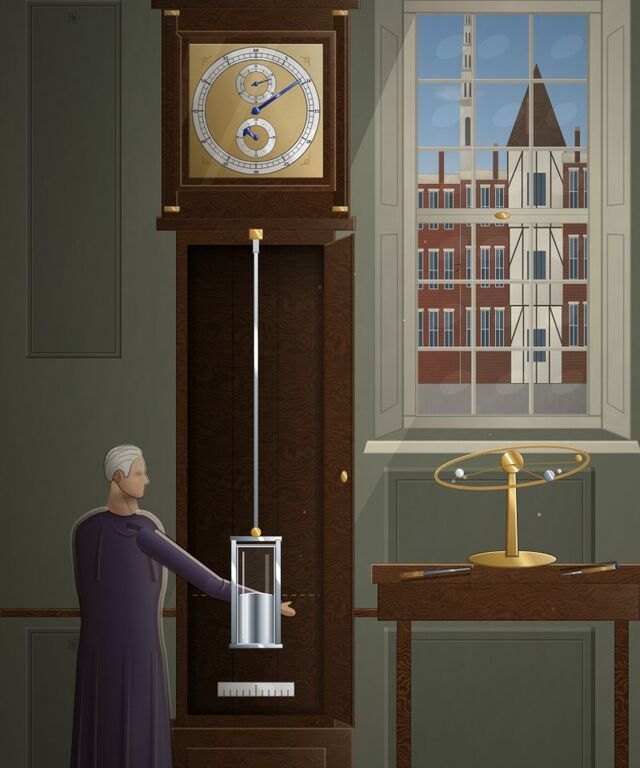
Heat is an enemy of precision. A pendulum's steel rod lengthens slightly as the temperature rises, and a longer pendulum swings slower, so a clock accurate in January could lose real time by August. George Graham, working from his shop on Fleet Street, solved the problem in 1721 with an elegantly simple trick: he replaced the solid bob at the bottom of the pendulum with a glass jar of mercury.
As the steel rod grew longer in the heat and let the jar hang lower, the mercury inside it also expanded, rising up inside the jar. The two effects worked against each other, and if Graham got the proportions right, the pendulum's effective center of swing barely moved at all. He described the invention to the Royal Society in 1726, alongside another refinement, the deadbeat escapement, the small mechanism that releases a clock's gear train one tooth at a time with each swing of the pendulum, giving a cleaner tick and far less friction. It became standard in precision clocks of the era.
Graham had inherited his workshop from his former master and eventual relative by marriage, Thomas Tompion. Fittingly, when Graham died in 1751, he was buried in Tompion's own grave in the nave of Westminster Abbey, where the two men still share a single stone.
The specific fix has long since been replaced by modern alloys that barely expand with heat at all, but the underlying problem, and the instinct to cancel it out, is one every watchmaker still designs around.