Stop 29 of 109 · A Gift from Baghdad
807 CE · Aachen, Carolingian court
The Clock That Amazed Charlemagne's Court
In 807, a Baghdad caliph sent the Frankish king a brass water clock that dropped bronze balls to ring out the hours, a gift so strange the court's own chronicle described it in wonder.
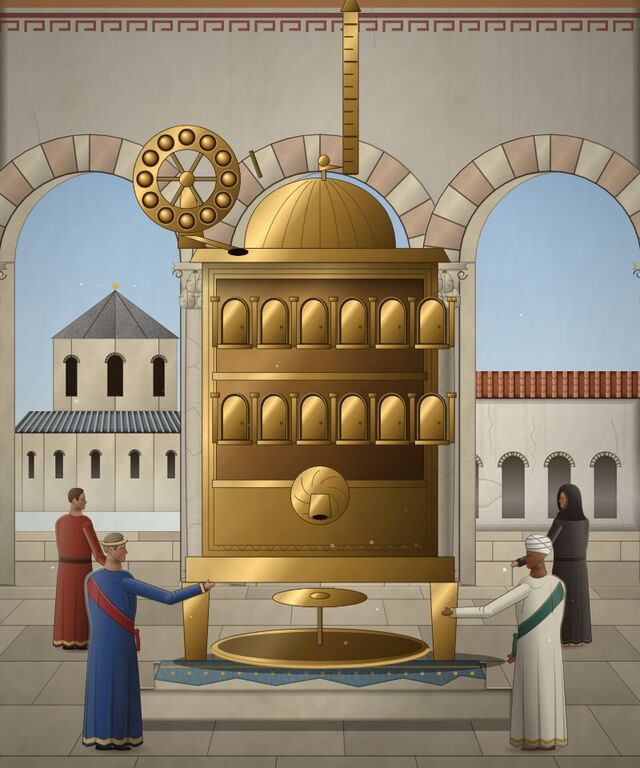
The Royal Frankish Annals record the moment plainly: in 807, an envoy named Abdallah arrived at Charlemagne's court in Aachen, sent by the caliph Hārūn al-Rashīd in Baghdad, bringing among other gifts "a clock of brass, wonderfully made by mechanical art, in which the course of the twelve hours turned by a water clock, with as many little bronze balls, which fell at the completion of the hours and by their fall rang a cymbal beneath." Twelve small horsemen, the annals add, rode out of twelve windows as the hours passed.
Read plainly, one ball dropped as each hour ended, so the balls collecting in the dish below counted out the hours as the day went on, three balls sitting in the dish after the third hour, and so on until midnight reset the count.
It wasn't the caliph's first extraordinary gift. Five years earlier, in 802, Hārūn had sent an elephant named Abul-Abbas, which lived at Aachen until 810, a sign of just how far the exchanges between the two courts reached.
No description of the clock's internal works survives; the annals record only what it did, not how. But the idea it carried, a clock announcing its own hours aloud, without anyone watching it, pointed toward the striking clocks that would spread across European towers centuries later, and that some watches still echo today with a chime.