Stop 30 of 109 · Six Candles a Day
c. 880 CE · Winchester, Wessex
King Alfred's Candles Weren't the First Clock of Their Kind
Alfred the Great is often credited with inventing the candle clock, but the idea was already centuries old by the time his chaplains lit theirs.
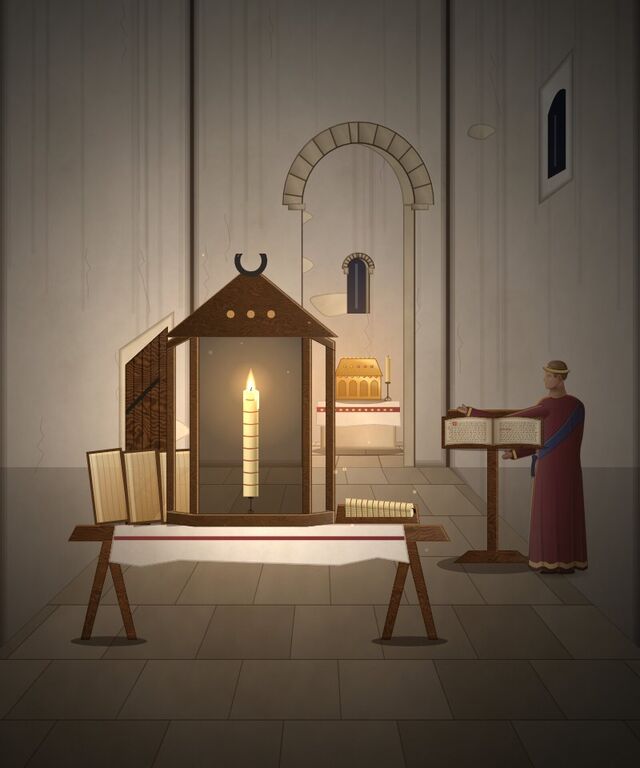
According to his biographer Asser, King Alfred wanted to give God a fixed share of every day and night, so he had his chaplains make six candles from 72 pennyweights of wax, each exactly twelve inches long and marked off inch by inch. Burning at a steady rate, each candle lasted about four hours; six of them, lit in sequence, carried him through a full day and night.
The plan had one flaw: wind. Draughts blew constantly through the doors, windows, wall-cracks, and thin canvas of the buildings Alfred used, making the candles burn unevenly and too fast. His solution was a lantern of wood and white ox-horn, shaved so thin it let light through almost like glass, protecting the flame while still letting him read its progress.
It's a charming story, and a real one, but not a first. Candle clocks were already known well before Alfred's time; a Chinese poem from around 520 describes one, more than three centuries earlier. What Asser actually documents isn't an invention but an adaptation: a working candle clock, carefully engineered against a very specific draught.
Whichever culture built the first one, the principle is identical to a watch's mainspring: power has to be released at a steady, even rate, or the reading it gives becomes worthless. Alfred's chaplains solved that problem with wax and horn; a modern watch solves it with steel and jewels.