Stop 31 of 109 · Wheels of Days
c. 900 CE · Chichén Itzá, Yucatán
The Maya Calendar That Took 52 Years to Repeat Itself
At Chichén Itzá, two interlocking counts of days lined up only once every 52 years, a cycle popularly tied to the site's famous pyramid by a story newer than it looks.
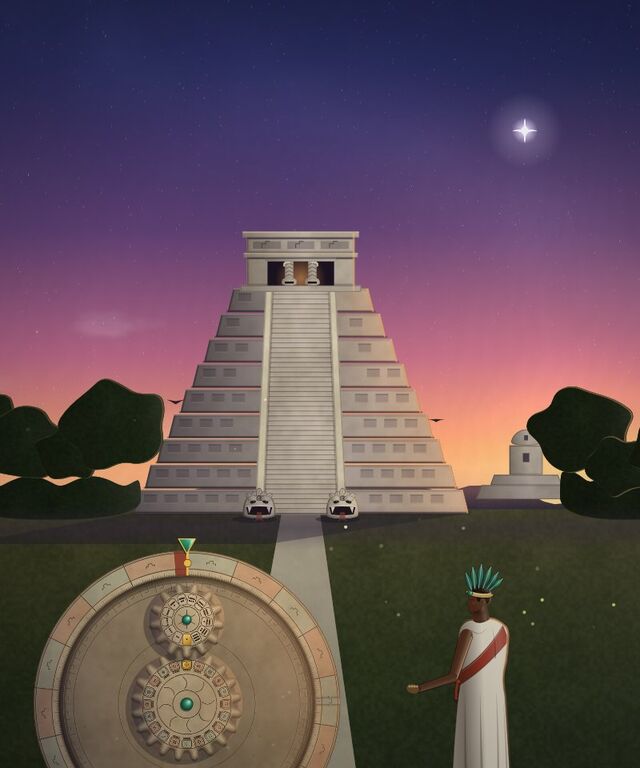
Maya timekeeping ran on two counts turning at once. The Tzolk'in paired 13 numbers with 20 day names for a cycle of 260 days; the Haab' ran 18 months of 20 days plus five unlucky extra days, Wayeb', for 365. Because the two cycles are different lengths, any single combination of Tzolk'in and Haab' dates returns only once every 52 years, 18,980 days, a span the Maya marked as an elder's moment of special wisdom. They tracked Venus too: five of its cycles align with almost exactly eight solar years.
At El Castillo, the stepped pyramid at the heart of Chichén Itzá, a popular modern story holds that the setting sun on the equinoxes throws a shadow down the staircase shaped like a slithering serpent, meeting a carved stone snake head at the base. The light effect itself is real. But researchers Ivan Šprajc and Pedro Sánchez Nava argue that the equinox-serpent story only began circulating in the 1970s, that the shadow actually lingers for weeks around the equinox rather than falling on one precise day, and that Mesoamericans themselves marked quarter-days rather than equinoxes specifically.
What's well established is the counting system underneath it all: two wheels of days turning at different rates, engineered so they synchronize only after a long, deliberate cycle, the same trick a watchmaker uses for a calendar complication that only needs correcting once in a very long while.