Stop 87 of 109 · Time from the Tower
1910 · Paris, Paris Observatory
The Radio Tower That Saved Itself by Telling Time
Built for an exhibition and due for demolition, the Eiffel Tower earned a lasting reprieve by broadcasting exact time to ships at sea.
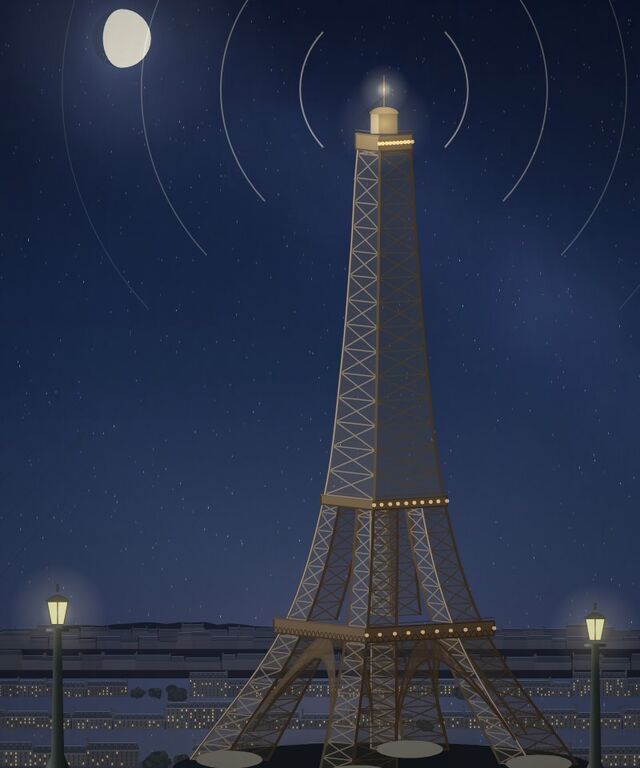
The Eiffel Tower was never meant to be permanent. Its original 1889 permit ran for twenty years, expiring at the end of 1909, after which Paris was, by the original plan, supposed to take it down.
It survived because, in the meantime, it had made itself useful. From 1903, a French army officer named Gustave Ferrié had been using the tower as a military radio station; by 1908, its transmissions reached some 6,000 kilometres. That reach was hard to give up, and on 1 January 1910 the tower's concession was extended by seventy years.
Soon after, in May 1910, the tower's station began broadcasting something else useful: the exact time, taken from the clocks of the Paris Observatory, sent out as radio beeps for anyone able to receive them. A ship at sea, listening through simple headphones, could check its chronometer, the precise onboard clock navigators depended on, against the signal, and a correctly set chronometer was essential for working out the ship's longitude.
The tower's usefulness as a time signal, alongside its usefulness as a radio mast, is generally credited as one of the reasons Paris chose to keep it rather than pull it down. It still broadcasts today, now carrying television and radio signals instead of time beeps, proof that the reprieve granted in 1910 never really ended.