Stop 55 of 109 · Swing and Count
1602 · Padua, Republic of Venice
The Swing Galileo Almost Finished
In 1602, a young mathematics professor in Padua wrote to a friend about two weights on strings and stumbled onto an idea that would run every clock for centuries.
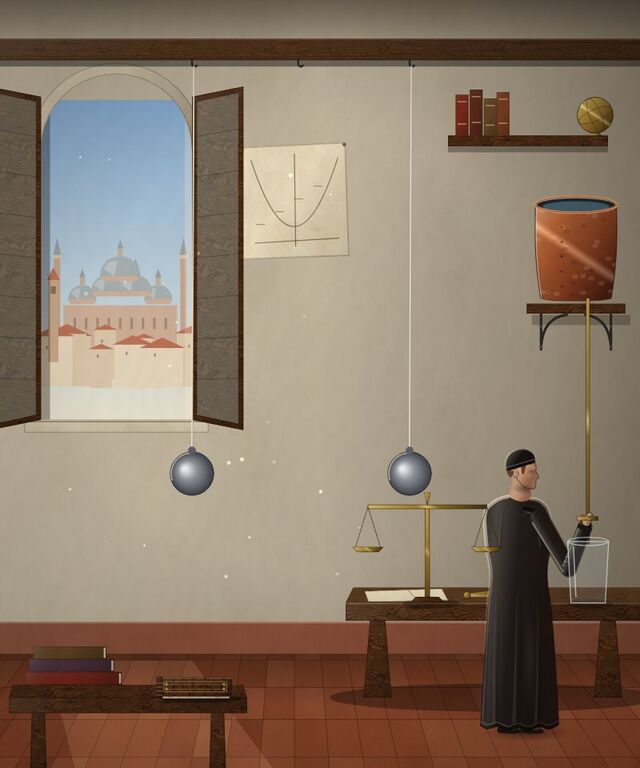
In 1602, Galileo Galilei was a professor of mathematics at the University of Padua, more interested in weights on strings than in the stars he would later study. In a November letter to his patron, he described two pendulums of different swing width, one wide and one narrow, that returned in almost exactly the same time. It was the discovery of isochronism, the property that would eventually anchor every mechanical clock.
A well-loved story credits the discovery to a lamp swinging in Pisa Cathedral, timed against his own pulse. It's a wonderful image, but it comes from a biography written by his student Vincenzo Viviani only after Galileo's death, and historians generally treat it as legend rather than fact.
What's certain is how Galileo actually timed things: not with a clock, since none was precise enough, but by weighing water. He let it trickle from a vessel through a thin pipe into a glass, then weighed the glass on a fine balance: more water in the glass meant more time had passed. He used the method to test falling and rolling bodies, and to confirm his pendulum law.
Late in life, blind, he sketched a design for a pendulum clock and asked his son Vincenzo to build it. It was never finished. That distinction belongs to Christiaan Huygens, who built the first working pendulum clock in the Netherlands in 1656.
Every mechanical watch today still carries a piece of that Padua letter: the balance wheel inside it swings back and forth on its own hairspring, keeping the same beat wide or narrow, just like the weights Galileo watched.