Stop 90 of 109 · Wind It With Your Wrist
1923 · Douglas, Isle of Man
The Watch That Wound Itself as You Walked
A repairer on the Isle of Man patented a wristwatch in 1923 that needed no winding crown at all, just the ordinary motion of a moving arm.
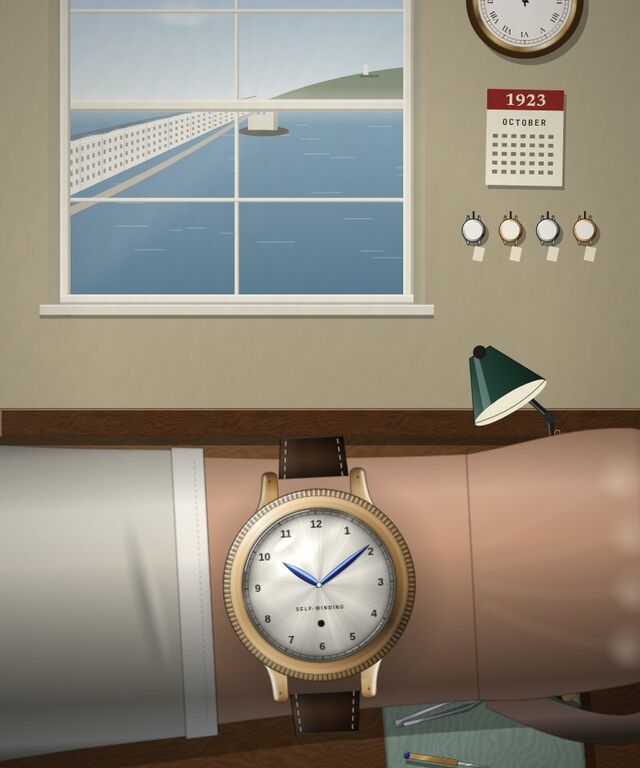
John Harwood, a watch repairer originally from Bolton, England, had settled on the Isle of Man after the First World War when he worked out a problem that had bothered watchmakers for years: winding a watch meant a hole in the case for the crown's stem, and that hole let in the dust and moisture that eventually wore a movement out.
His solution, patented with Harry Cutts in 1923, removed the crown entirely. Inside the case, a half-moon-shaped weight pivoted freely and swung back and forth against two spring buffers as the wearer's arm moved through an ordinary day, and that swinging motion, through a small mechanism, wound the mainspring automatically.
Without a crown, the hands had to be set another way: by turning the watch's outer bezel, with a small coloured disc in a window on the dial showing when the watch was in "setting" mode rather than running normally. Harwood's watches went into production in Switzerland and reached British shelves, at Selfridges in London, in November 1928.
It wasn't quite the first self-winding watch ever; self-winding pocket watches date back to the 1770s, and another watchmaker had built a few automatic wristwatches the year before Harwood's patent. But Harwood's design is the direct ancestor of the automatic watch as it's built today: nearly every mechanical watch that winds itself still does it with a swinging weight, now generally called a rotor, doing the same job as Harwood's half-moon a century ago. His own company didn't survive the 1931 slump, but the idea did.