Stop 89 of 109 · Synchronise Watches
1916 · Western Front, First World War
The War That Put the Watch on the Wrist for Good
Soldiers in the First World War needed to check the time without letting go of their weapons, and made the wristwatch, once considered women's jewelry, ordinary for men.
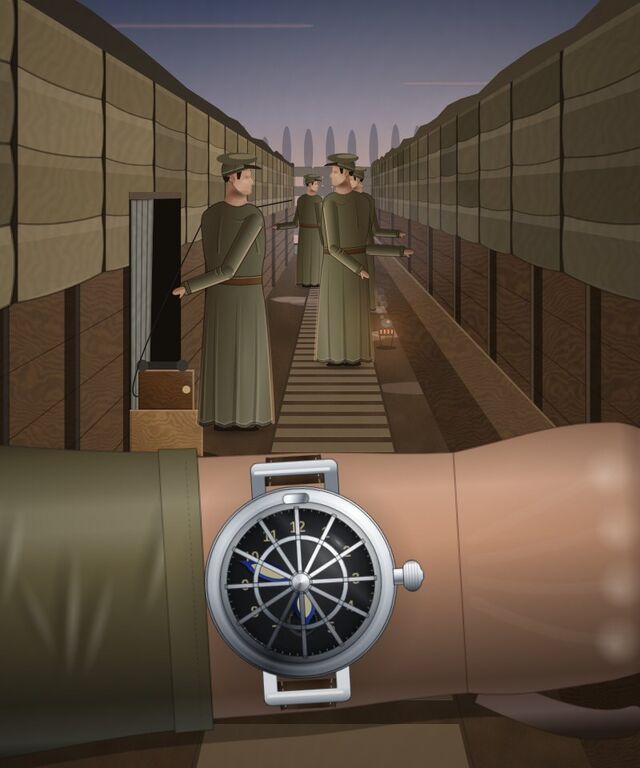
Before 1914, a man wearing a watch on his wrist was, to many people, wearing something feminine: pocket watches were the masculine standard, tucked into a waistcoat and checked with a free hand. A trade journal writing in 1917 put it plainly: wristwatches had been "little used by the sterner sex" before the war.
The war changed that within a few years. Coordinating an attack meant every officer along a line had to act at the same minute, which meant checking a watch constantly against official time relayed by army signallers, awkward to do with a pocket watch while also holding a weapon, using field glasses, or simply keeping both hands free in a trench.
Watchmakers adapted quickly: soldering wire lugs onto ordinary pocket watch cases so they could take a strap, or fitting a pocket watch into a leather wristlet cup. Dials were painted with radium so they could be read in the dark, and from late 1915 the fragile glass was often replaced with tougher, unbreakable celluloid.
None of this technically invented the wristwatch: officers had worn "wristlets" as far back as the 1880s in colonial postings. What the war did was make wearing one, for a man, completely unremarkable. By the time the fighting ended, that same journal noted, the wristwatch was on the arm of nearly every man in uniform.