Stop 44 of 109 · The Self-Striking Clock
1434 · Hanyang, Joseon Korea
The Clock That Struck Itself, Built by a Man Born Enslaved
Korea's self-striking water clock of 1434 rang bells, drums and gongs with no one touching it, and it was built by a servant King Sejong chose to promote.
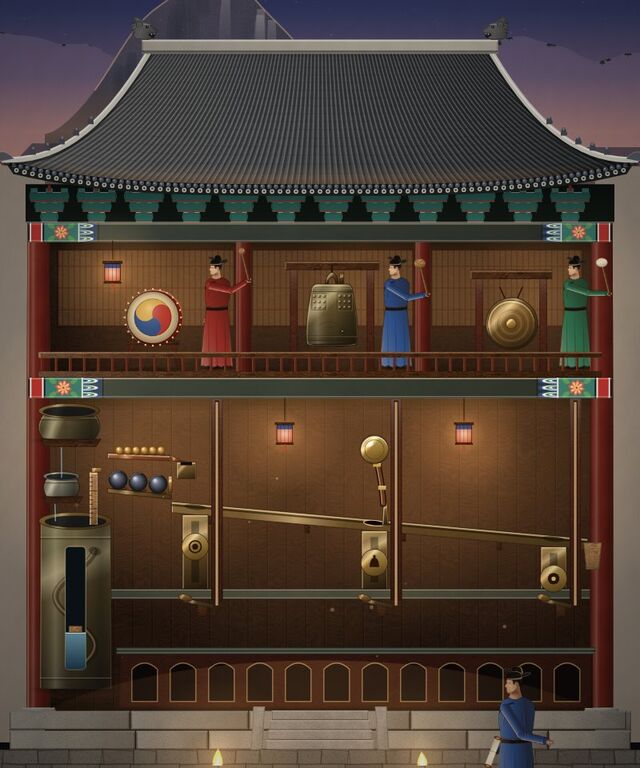
In 1434, the engineer Jang Yeong-sil built a water clock for King Sejong that needed no one to watch it. Inside the Borugak pavilion at Gyeongbokgung Palace, water flowed steadily from a set of supply vessels into a receiving one, where a float rose with the water level. At each hour, the float released a small ball; the small ball tripped the release of a much larger iron ball, 'big as a hen's egg'; and the falling iron ball landed on a lever that reached up inside a pillar to strike a figure's arm.
Three wooden figures did the announcing: one struck a bell for the hours, one a drum for the night watches, one a gong for the smaller divisions between them. Twelve spirit-figures on a wheel rose in turn to display the hour's name.
Jang himself was an unlikely royal engineer. He was born a nobi, a servant owned by the government and ranked at the very bottom of Joseon society. Sejong recognized his gift for building machines and had him raised to a post at court, a rare crossing of one of Korea's strictest social lines, made possible by what Jang could build.
The clock's basic trick, a small, precisely timed release letting a hammer fall, is still how a striking or chiming watch works today, just without the water.