Stop 43 of 109 · Forge the Train
1410 · Prague, Old Town
The Clock the City Blamed on a Blinding
Prague's astronomical clock has outlived its builder's name, and a legend that was never true.
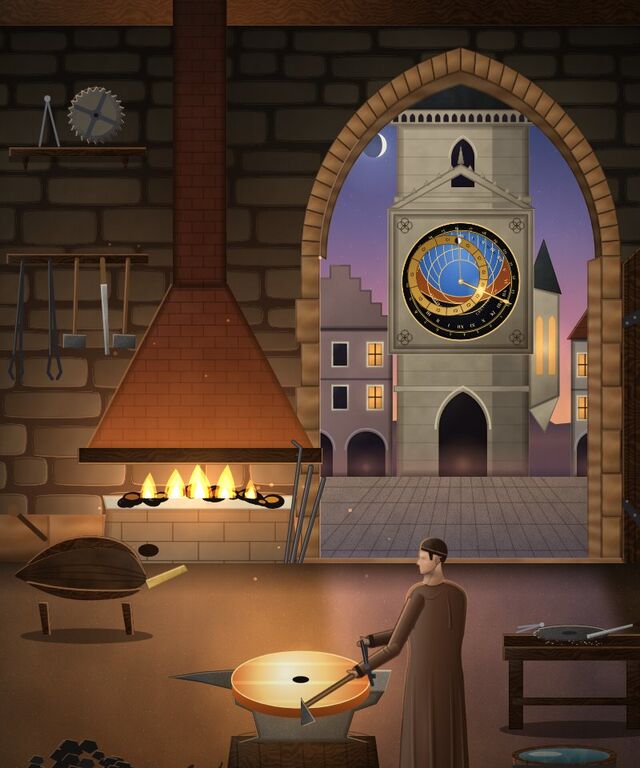
Prague's Orloj has run on the Old Town Hall tower since 1410, its astronomical dial turning through a mechanism of falling weights and meshing gears that most visitors never see: a clockmaker named Mikuláš of Kadaň built it with the astronomer Jan Šindel, using a swinging foliot to let the weight down in measured steps.
A gear train is simple arithmetic made physical. Each wheel divides the turning of the one before it: a wheel of 72 teeth driven by a pinion of 6 teeth turns twelve times as slowly, which is exactly what's needed to make an hour hand complete one lap every twelve hours. Cut the right combination of teeth, and the gears do the counting for you.
For centuries, a darker story circulated: that the clock's maker, a man named Hanuš, was blinded by the city's councillors so he could never build its equal for a rival town. It is a vivid tale, and a false one: a legend, not history. Records place Mikuláš of Kadaň as the 1410 builder; a real clockmaker named Hanuš did work on the Orloj, but only decades later.
The mechanics, at least, need no embellishment. A modern watch turns a fast-ticking balance wheel, the small weighted wheel that swings back and forth many times a second, into a slow-moving hour hand through the same kind of gear division the Orloj performs, just smaller, and quieter.