Stop 42 of 109 · Knights on the Hour
c. 1390 · Wells, Somerset
The Knights Who Have Jousted for Six Hundred Years (Almost)
Wells Cathedral's clock puts on a tiny tournament every quarter hour, a tradition newer than it looks.
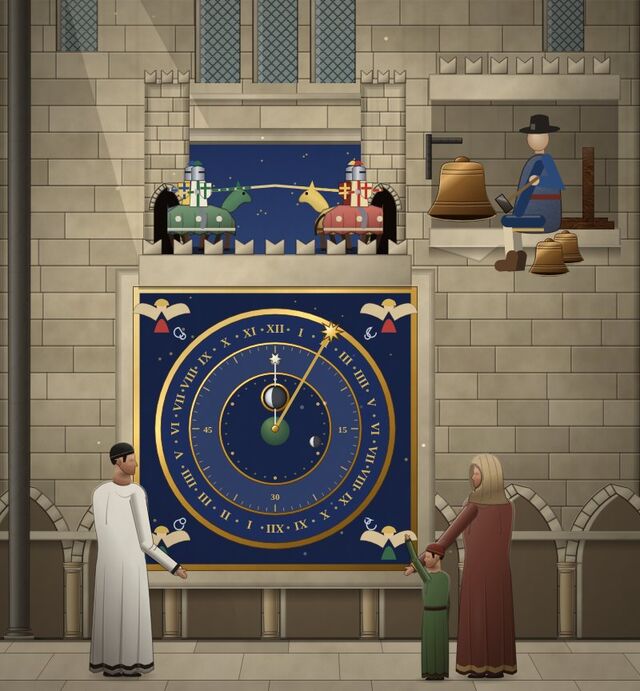
High in the north transept of Wells Cathedral, a dial nearly two metres wide shows something closer to a diagram of the heavens than a modern clock face: the hours run I to XII twice round a 24-hour circle, noon at the top, a gilded sun-star pointing the hour and a smaller star the minutes, with the moon's age and phase turning above the centre. Four angels sit in the corners, holding back the four winds.
Above the dial, model knights on horseback circle and joust, one knocked from his horse each pass. Off to the side, a figure known as Jack Blandifer strikes the hour on a bell with a hammer and kicks two smaller bells with his heels for the quarters: two strokes at quarter past, six at quarter to.
The works are old, dating from around 1390, not long after a similar clock was installed at Salisbury by the same bishop. But the spectacle visitors see today isn't quite the medieval original: the movement itself was replaced in 1837 (the old one now runs in London's Science Museum), and the knights, who used to charge only once an hour, have jousted every fifteen minutes only since the 1960s.
Even softened by those changes, Wells still does something clocks rarely do anymore: it turns the passing of time into a small public performance. A watch with a minute repeater, a mechanism that chimes out the time on tiny gongs at the press of a button, or a quarter-striking complication that does the same on its own every fifteen minutes, is chasing that same idea, in miniature, on a wrist.