Stop 21 of 109 · The Year of Confusion
46 BCE · Rome, Roman Republic
The Year Julius Caesar Made 445 Days Long
To rescue a calendar that had drifted three months out of step with the seasons, Rome once lived through a single year stretched to 445 days.
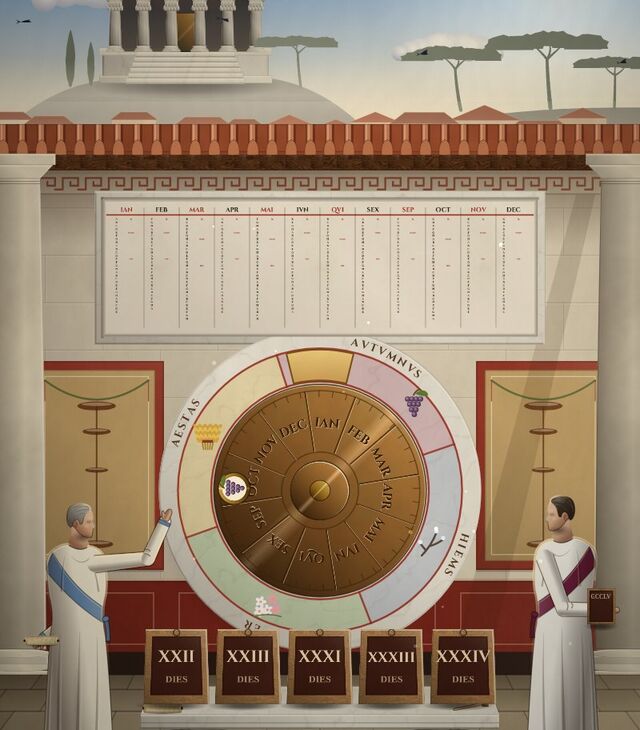
By 46 BCE, the Roman calendar was a mess. In principle, an occasional extra month kept its 355-day year lined up with the sun; in practice, the priests responsible for inserting it, the pontiffs, often skipped it, sometimes for political convenience. The civil calendar had drifted roughly three months ahead of the actual seasons. As the historian Suetonius put it, the harvest festivals no longer fell in summer, nor the vintage festivals in autumn.
Julius Caesar, who oversaw the calendar in his role as Pontifex Maximus, the head of Rome's state priesthood, brought in the Alexandrian astronomer Sosigenes to fix it properly. Their solution was blunt: let one year run long enough to catch up completely. On top of the usual extra month, they inserted two further months between November and December. In total, 46 BCE ran 445 days: what Romans afterward called the "last year of confusion."
From 1 January 45 BCE, the calendar reset to 365 days a year, with an extra day added every fourth year: essentially the leap year still used today, lightly refined in 1582.
Even this fix briefly went wrong. After Caesar's death, the pontiffs miscounted and inserted the leap day every third year instead of every fourth; Augustus had to skip several leap years afterward to bring the count back in line. And Caesar's own birth month, Quintilis, was renamed in his honor: July.