Stop 22 of 109 · Count Like the Maya
36 BCE · Chiapa de Corzo, Chiapas
The Calendar That Didn't Predict the End of the World
A broken stone from a Mexican hillside carries one of the oldest known Long Count dates, the same counting system later, wrongly, blamed for a 2012 apocalypse.
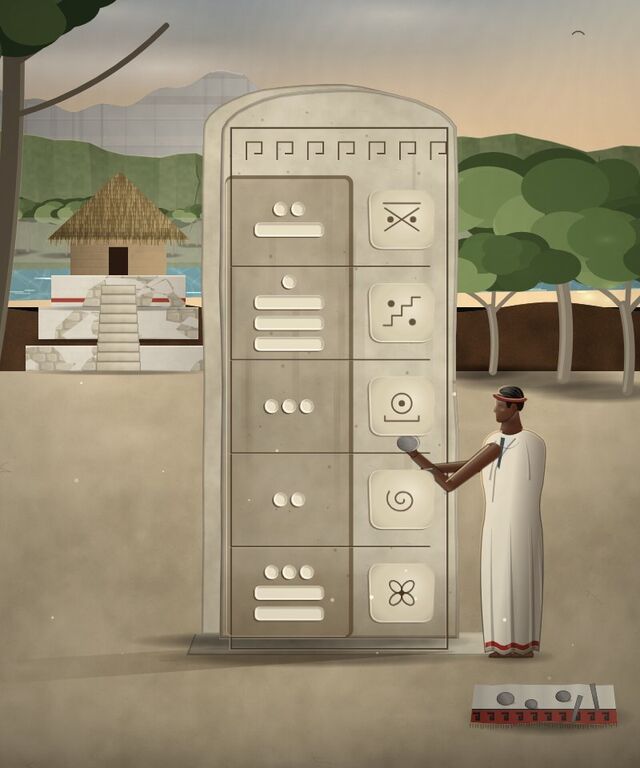
The Long Count is, at heart, a place-value counter, not unlike the way a watch rolls seconds into minutes and minutes into hours. Days, k'in, roll into 20-day units called winal; 18 winals make a tun of 360 days, the one place in the system that breaks the usual pattern of twenties; 20 tuns make a k'atun, and 20 k'atuns a b'ak'tun. Numbers were written with dots worth one and bars worth five, and, remarkably early for any counting system, a shell sign stood for zero.
At Chiapa de Corzo, a town of Zoque speakers on a bluff above the Grijalva River in what's now Chiapas, Mexico, a carved stone panel known as Stela 2 carries a date read as 7.16.3.2.13: December, 36 BCE. It's fragmentary: the top two numbers had to be reconstructed by scholars, and at least one alternate reading has been proposed. Even so, it stands among the oldest known Long Count dates, predating the Maya's own famous use of the system among their epi-Olmec neighbors.
The Long Count's starting point sits far in the past, on 11 August 3114 BCE by the usual correlation, and counts forward from there. On 21 December 2012, the count reached 13.0.0.0.0, a new b'ak'tun, the same kind of rollover an odometer makes at 100,000 miles. Some took this as a prophecy of doom. No surviving Maya text says anything of the sort.
It's simply a counter reaching a round number, the way a watch's date wheel turns over at midnight, nothing more, and nothing the Maya themselves ever framed as an ending.