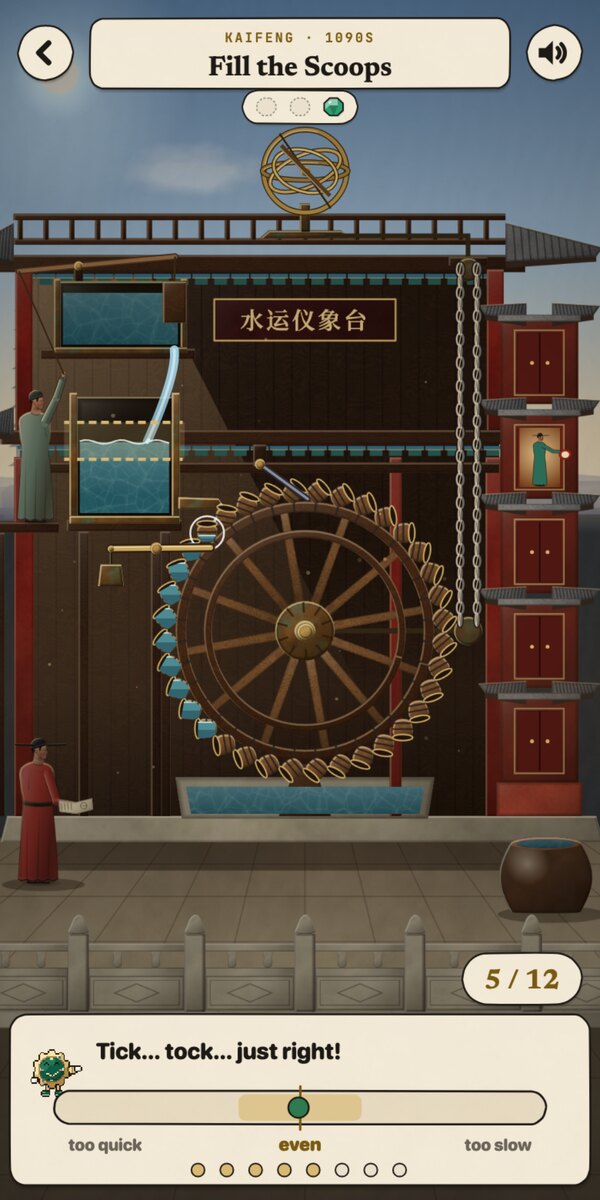
Stop 35 of 109 · Fill the Scoops · 7 min read
1090s · Kaifeng, Song China
The Clock Tower Nobody Could Rebuild
Su Song's water-powered tower in Song-dynasty Kaifeng stepped forward one scoop at a time and announced the hour through 133 moving figures, until it was dismantled and its secret was almost lost.
Fact rating: EstablishedFact rating
taken apart after 1127, and no one could rebuild it. his illustrated book saved the design.
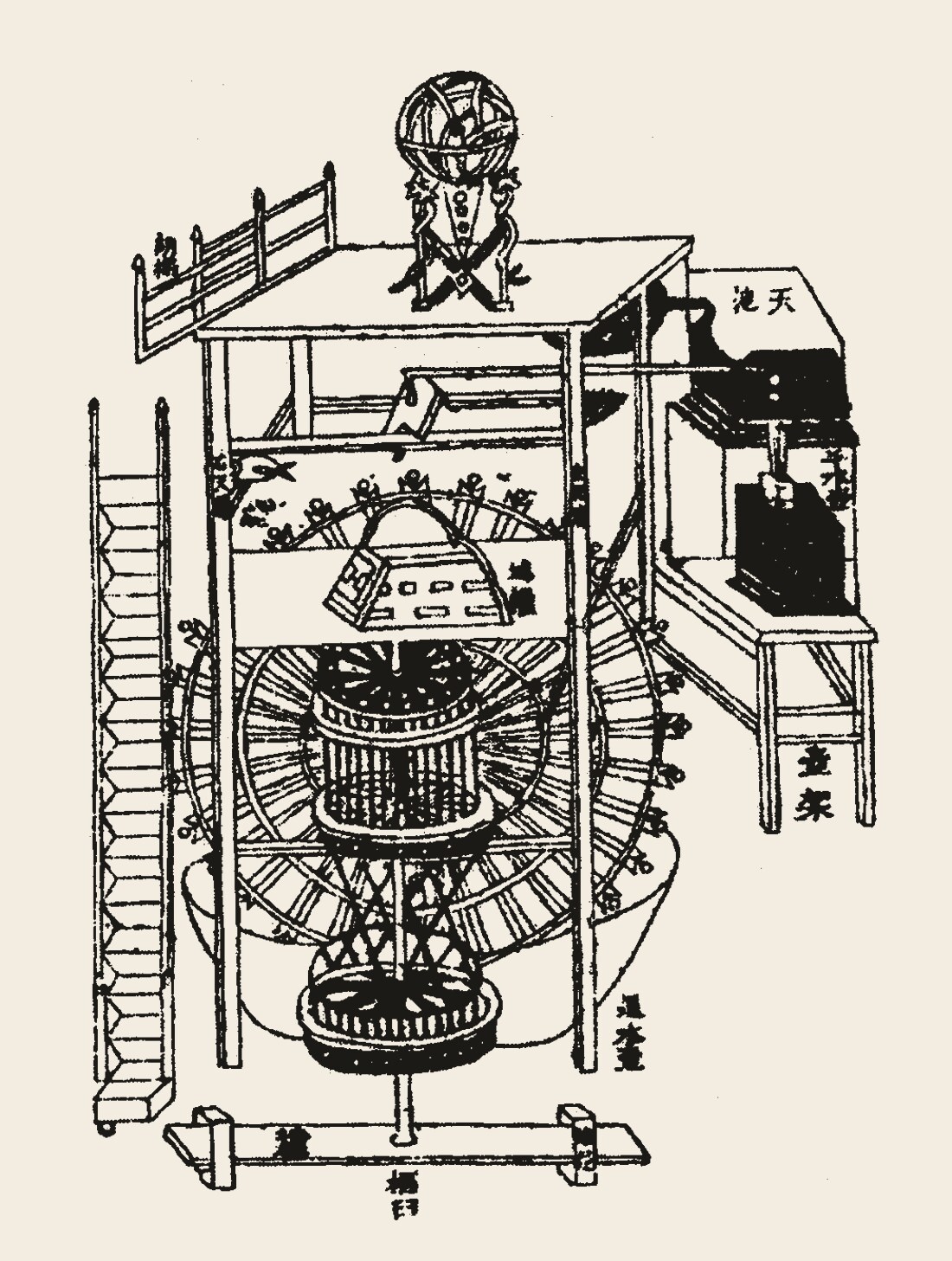
Around 1090, the scholar-official Su Song built a clock tower in Kaifeng, then the capital of Song China, standing perhaps 12 metres tall. Its heart was a great wheel fitted with 36 scoops, fed one at a time from a steady tank of water above. When a scoop filled enough, its weight tipped a balance and the whole wheel lurched forward exactly one step, no more, no less.
That stepping wheel turned an armillary sphere on the roof, a star globe inside and a troupe of wooden figures at the windows. It ran for less than forty years. Here is a longer look at who built it, how it worked, why nobody could rebuild it, and why historians still argue over what to call it.
An old official and a mathematician
Su Song was born in 1020 in Tong'an, now part of Xiamen in Fujian, and rose through the civil service to become Minister of Punishments. He was also an expert on the calendar. In 1077 he travelled north on an embassy to the Liao, the Khitan empire on the Song border, and afterwards had to admit to his emperor that the Liao calendar was a little more accurate than the Song one.
In 1086 the court asked him to build a new armillary clock for the capital. The historian Liu Heping argues that Emperor Zhezong backed it partly to compete with the Liao for scientific prestige. Su Song was in his late sixties. He did not work alone: Han Gonglian, an official in the Ministry of Personnel, brought the mathematics, and a team of craftsmen did the building.
The dates depend on which moment you count. A working version in wood was finished in 1088, the year most Western accounts give for the clock. Its parts were then remade in bronze, some 20,000 catties of metal, about 12 tonnes. Chinese reference works put the completion of the whole in 1092; some English accounts say 1094.
One scoop at a time
The power came from water, and the first problem was keeping it steady. Water running from a tank comes out fast when the tank is full and slows as it empties. The answer, used in China since Zhang Heng added an extra tank in the 2nd century, was a pair of tanks: the upper kept the lower at a constant level, so the jet into the wheel never changed. At the foot of the tower, men turning a hand wheel lifted the spent water back up.
The driving wheel was about 3.4 metres across, with 72 spokes holding 36 scoops. Each scoop under the jet rested on a steelyard, a balance arm with a counterweight like a market scale, while a lock at the top held the wheel still. Once the scoop held enough water it tipped down onto a trip lever. Through a chain and a second balance arm above, that jerked the upper lock open; the wheel, heavier on its full side, swung round by exactly one scoop, and the lock dropped back in front of the next spoke. A second lock stopped the wheel from rolling back.
The arrangement was called the tianheng, the celestial balance. Its rhythm came not from the levers but from the water: how long the jet took to fill a scoop to its tipping weight. Change the amount of water a scoop needed before it tipped, and the keepers could correct the clock's rate, much as a watchmaker nudges the regulator on a watch.
A sky on the roof, a show at the door
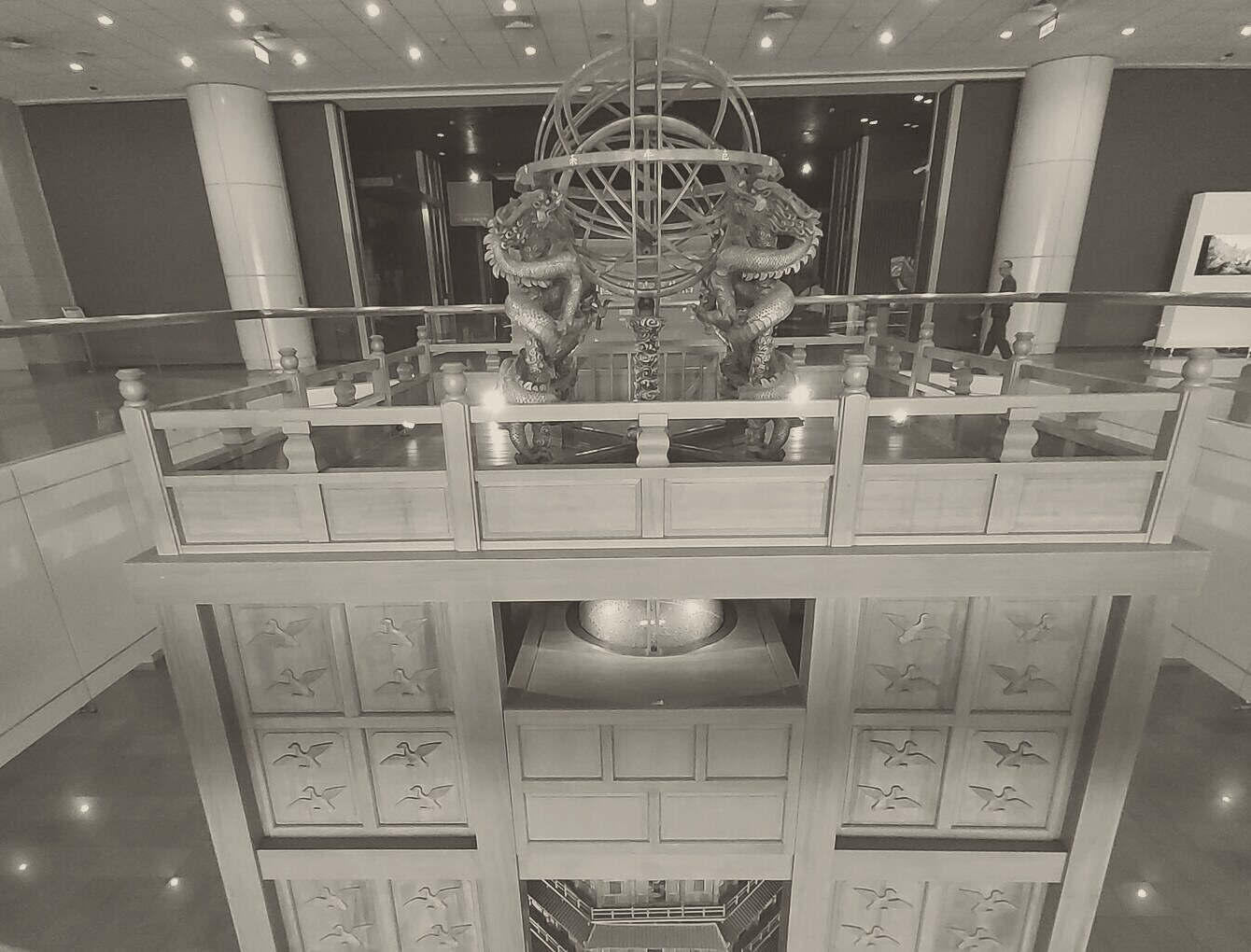
That motion climbed the tower through gears and an endless chain, driving an armillary sphere near the top, a set of nested rings modelling the sun, moon and stars as they cross the sky. It stood on the top platform under a roof whose boards could be lifted off for observing, an early version of the opening roof of a modern observatory. Below it, in a closed room, a celestial globe dotted with stars turned once a day, half hidden inside a wooden case.
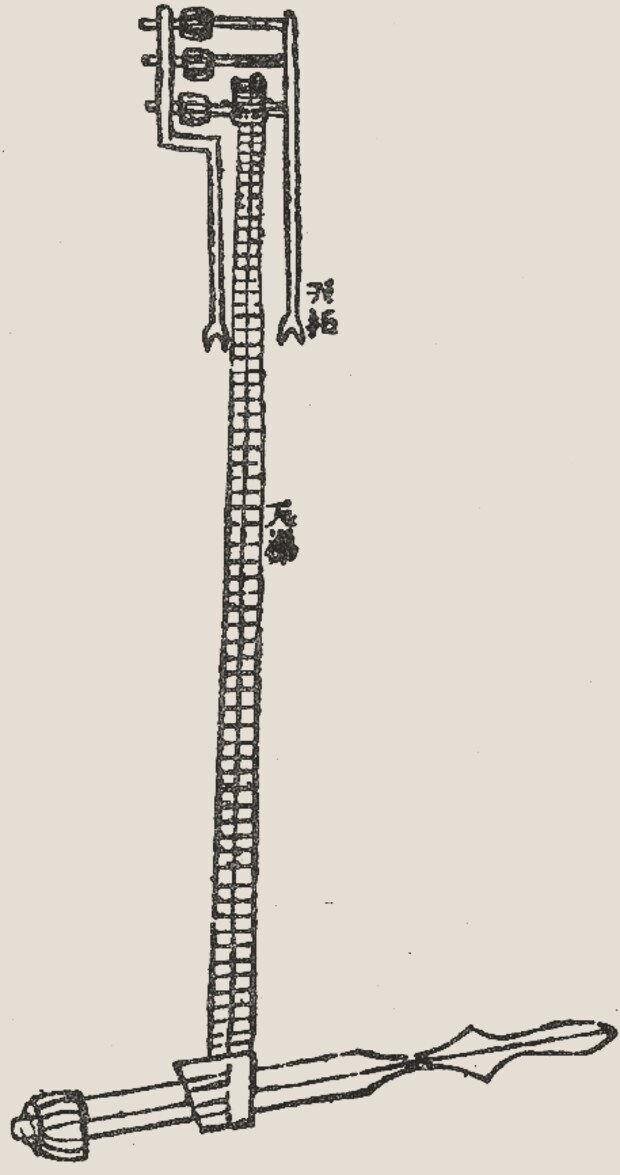
The chain, which Su Song called the celestial ladder, was an iron loop about 5.9 metres long, running from the main drive shaft up to the gearing under the sphere. His book holds the oldest known drawing of an endless chain carrying power continuously from one shaft to another. Philo of Byzantium had used chains in a Greek repeating catapult some 1,300 years earlier, but not to pass power on continuously; the likelier ancestor is the Chinese chain pump, used to lift water since the Han dynasty.
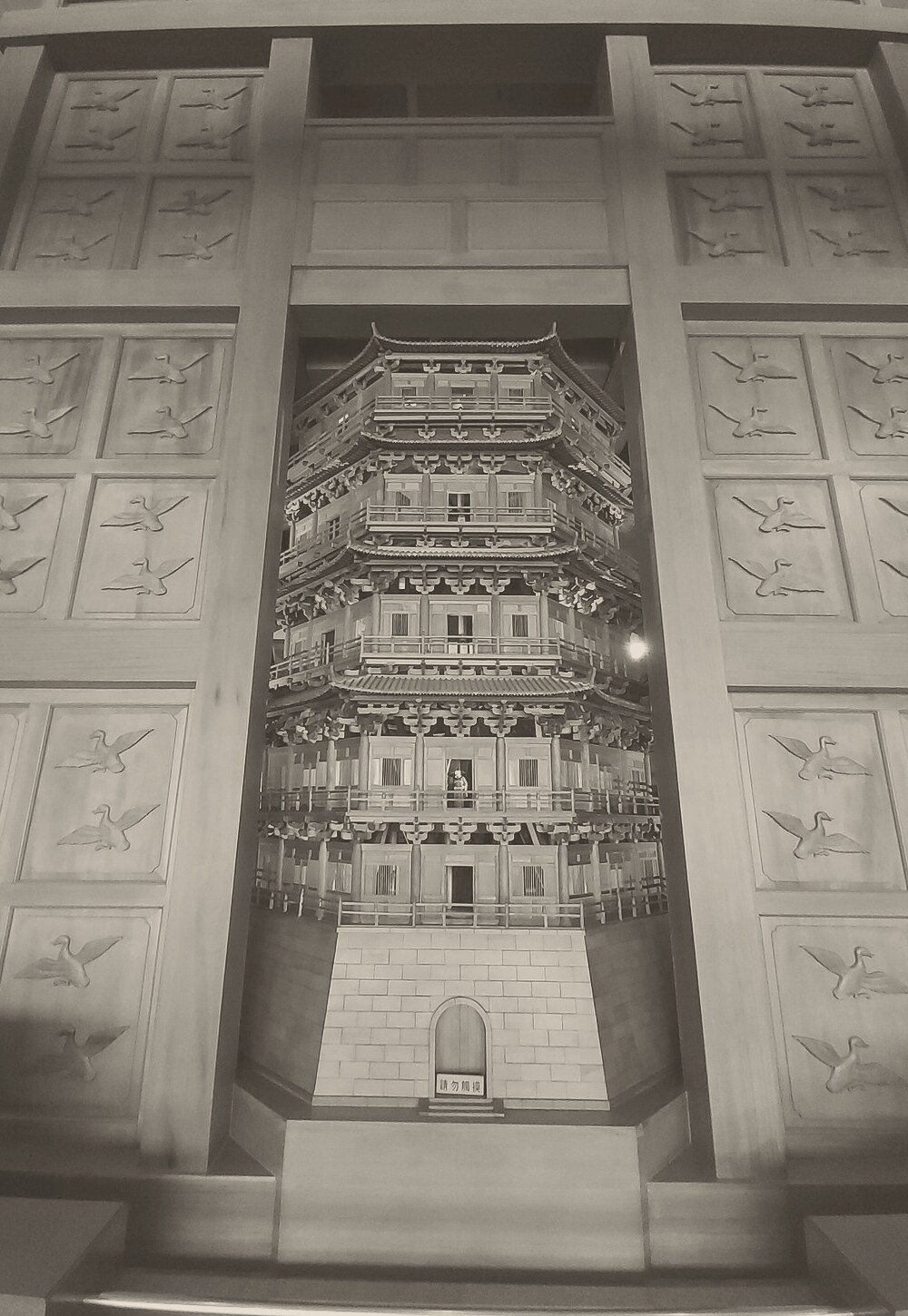
At the front of the tower, a five-storey wooden pagoda put on the show. On the top storey, one figure rang a hand bell at the start of each double hour, another struck a bell at its middle, and a third beat a drum at every ke, a hundredth of a day, or 14 minutes and 24 seconds. Lower storeys showed figures holding tablets for the hours and the ke, and at night a figure struck a gong for the night watches.
How many figures? The dek above says 133, the number usually given in English and traced to Joseph Needham's work. The Encyclopedia of China counts them storey by storey, 3, 24, 96, 1 and 38, which comes to 162. Either way, well over a hundred figures took turns at the doors.
Taken apart, and never put back
The tower did not survive Kaifeng's fall to invaders. In 1127 the armies of the Jurchen Jin dynasty sacked the city and carried off the emperor, his father and much of the court. They also dismantled the clock tower and took it north to Yanjing, today's Beijing, but could not work out how to put it back together. One account says the parts stood at the Jin observatory until 1214, when the Jin court moved south and left them behind.
In the south, the new Song emperor, Gaozong, ordered Su Song's son Su Xie to build another. Su Xie had his father's book and a team of experts, and still failed. He came to believe his father had left out essential parts on purpose. The philosopher Zhu Xi later judged that key sections of the book had been cut, probably to keep them secret.
What saved the design from being lost entirely was Su Song's own illustrated treatise, the Xin Yixiang Fayao, roughly New Design for an Armillary Sphere and Celestial Globe. The usual dates are 1092 for the text and 1094 for its printing; a 2021 engineering study gives 1094 to 1096. Its woodblock drawings, 47 by one count and more than 60 by another, show the tower whole and part by part. It was printed again in the south in 1172, the edition behind the modern reprints. As plans they have gaps: one modern team found only the celestial globe dimensioned more or less completely.
Building it again
The book reached a wide Western audience through Joseph Needham, Wang Ling and Derek de Solla Price, whose 1960 study Heavenly Clockwork set the tower in a long Chinese line of water-driven astronomical clocks. In China, Wang Zhenduo of the Chinese History Museum built a one-fifth scale model in the 1950s. In Britain, John Combridge, a Post Office engineer, and Aubrey Burstall of Newcastle built rival working models of the escapement, and in 1965 the Science Museum's workshops made a one-sixth scale model of it.
The first full-size working replica took longer. At the National Museum of Natural Science in Taichung, Taiwan, a small team around the researcher Kuo Mei-fang worked from the book's simplified sketches, inferring the missing dimensions, and had their tower turning once a day by 1993. Early on, wet wood swelled, the wheel jammed, or the escapement let go and skipped several scoops, spilling water across the floor. The replica, about 12 metres high, still stands in the museum, with a pump lifting the water instead of a team of carriers.
Others followed. A team led by Sun Xiaochun of the Chinese Academy of Sciences published a new reconstruction of the mechanism in a 2015 handbook. A full-scale replica stands in Su Song Park in Xiamen, and the Science Museum in London keeps a 1:48 model of the whole tower. In 2021 a team from National Cheng Kung University in Taiwan used Su Song's mechanism to reconstruct the lost clock of the 8th century that came before it.
Is it really an escapement?
Su Song did not start from nothing, and said so. He named as his predecessor the same Zhang Heng, who turned an armillary sphere by water. In 725 the monk Yi Xing and the engineer Liang Lingzan built a water-driven globe checked by locks, which Needham called the first escapement (see Did a Bronze Sky in Tang China Hide the First Escapement?). In 976 Zhang Sixun built a tower that ran on mercury, which would not freeze in winter. After he died, Su Song wrote, no one could repeat it.
Needham called Su Song's mechanism a water-wheel link-work escapement, and the Chinese clocks a missing link between ancient water clocks and the mechanical clocks of Europe. Not everyone accepts the word. In a mechanical clock, the beat comes from something that swings back and forth, and the escapement releases the wheels at that beat. In Su Song's tower nothing swings: the rhythm came from water filling scoops. Needham's critics, among them the historians David Landes and Carlo Cipolla, hold that the first truly mechanical clock was European, and that Needham stretched the word escapement to cover a periodic water-scoop mechanism.
The newer engineering studies split the difference. The 2021 Taiwanese study describes the device in two parts: a steelyard that produced the regular, repeating motion, and an escapement that controlled the wheel. The Science Museum calls it a waterwheel that functioned as an escapement. What nobody disputes is the principle: stored power let out in equal steps, by a lock that holds, releases and catches again.
From a scoop to a pallet fork
The core idea inside the tower, letting stored power escape in equal, repeatable steps rather than all at once, is exactly what an escapement does inside a mechanical watch today. Su Song's version used water and a tipping scoop instead of a spring and a pallet fork, the small lever that lets a watch's gears advance one tick at a time. His wheel stepped whenever a scoop was full; the balance in a modern watch beats 6, 8 or even 10 times a second.
There is no evidence that the tower led to Europe's clocks. Needham thought word of such machines might have travelled west; other scholars doubt it. The line that runs to your wrist passes through medieval Europe and, much later, through the lever escapement almost every mechanical watch still uses. But the problem Su Song solved in Kaifeng, turning a steady push into even, countable steps, is the one every watch solves, many times a second.