Stop 14 of 109 · Read the Falling Water
c. 1380 BCE · Karnak, Temple of Amun
Telling Time After the Sun Goes Down
A sloping stone bucket, made for a pharaoh's temple, is Egypt's oldest surviving water clock. Its shape was no accident.
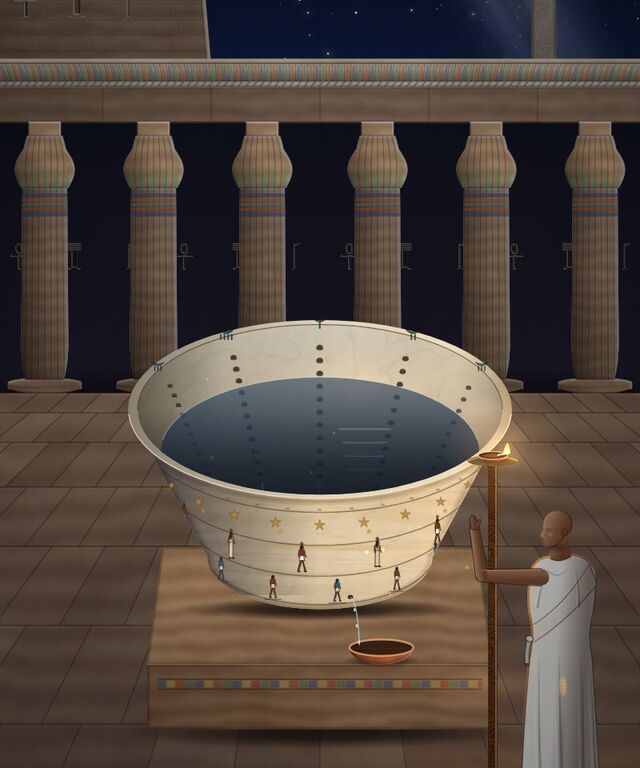
Sundials are useless after dark, which left ancient Egyptian priests with a problem: temple rites at Karnak needed to continue through the night. The solution, commissioned under Amenhotep III around 1380 BCE, was a clepsydra, a bucket of calcite (Egyptian alabaster) roughly 35 centimetres tall, with a small hole bored near its base.
Filled at sunset, the bucket dripped steadily through the night. Marked on the inside were twelve columns of small holes, one column for each month of the Egyptian year, since winter nights run longer than summer ones and each month needed its own scale calibrated to match.
The vessel's sloping sides matter as much as the columns of holes. In an ordinary straight-sided pot, water under more pressure near the bottom drains faster when the vessel is full, and slower as it empties, so the dripping rate keeps changing. Karnak's water clock, by starting wide at the top and narrowing toward the base, keeps that rate far more even than a straight pot would, though not perfectly, which is exactly why each month's marks still had to be individually calibrated rather than evenly spaced.
Found in pieces at Karnak in 1904 and now held in the National Museum of Egyptian Civilization, it is the oldest surviving water clock we have physical evidence for, a night-shift counterpart to the sundial, keeping time by drips instead of shadows. The problem it only partly solved, a power source that pushes harder when it's full and weaker as it empties, is the same one a mainspring gives a mechanical watch, and it would take a few centuries yet for anyone to fix it properly.