Stop 13 of 109 · Flip at Noon
c. 1450 BCE · Thebes, Egypt
A Clock You Had to Turn Around at Noon
One of the oldest portable timepieces in history worked perfectly all morning, then had to be physically flipped to keep working in the afternoon.
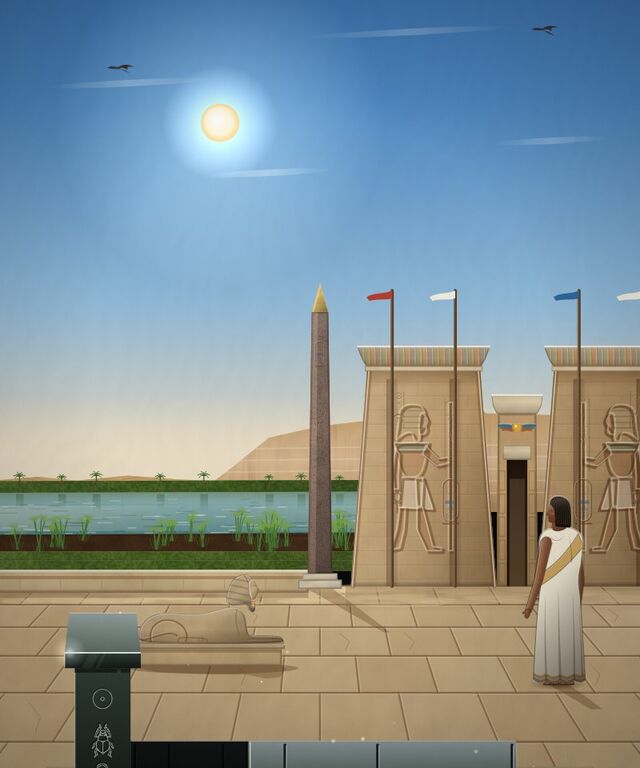
Among the objects connected to the reign of Thutmose III, around 1450 BCE, is a shadow clock: a stone bar just over 23 centimetres long with a raised crosspiece at one end. Set facing east in the morning, the crosspiece cast a shadow across a row of marks along the bar's length, and as the sun climbed, the shadow shortened.
By noon the shadow had nowhere left to go, so the device had a built-in limit: it had to be lifted and turned to face west for the afternoon, or its hours would simply run backward. It is a small, practical reminder that early instruments often mirror the sky's asymmetry rather than smoothing it away.
Egyptian daylight was divided into twelve hours this way, and the night into another twelve, marked instead by the rising of decan stars, fixed groups of stars whose appearance on the horizon signaled the start of each hour. Because both counts split whatever light or darkness was available into twelve equal parts, an Egyptian hour was not a fixed length: it stretched in summer and shrank in winter, following the season rather than a clock.
The twelve-hour dial still standard on most watches today descends directly from this Egyptian habit of splitting daylight into twelve. What changed since Thutmose III's time is simply that an hour now holds still, exactly sixty minutes, whatever the season.