Stop 12 of 109 · The Star Clock · 7 min read
c. 2100 BCE · Asyut, Middle Egypt
A Star Table Painted Inside a Coffin Lid
To mark the hours of the night, some ancient Egyptian coffin-makers painted a diagonal grid of rising stars on the inside of the lid.
Fact rating: AcceptedFact rating
the star tables are real. what they were for, a clock or an almanac for the afterlife, is less certain.
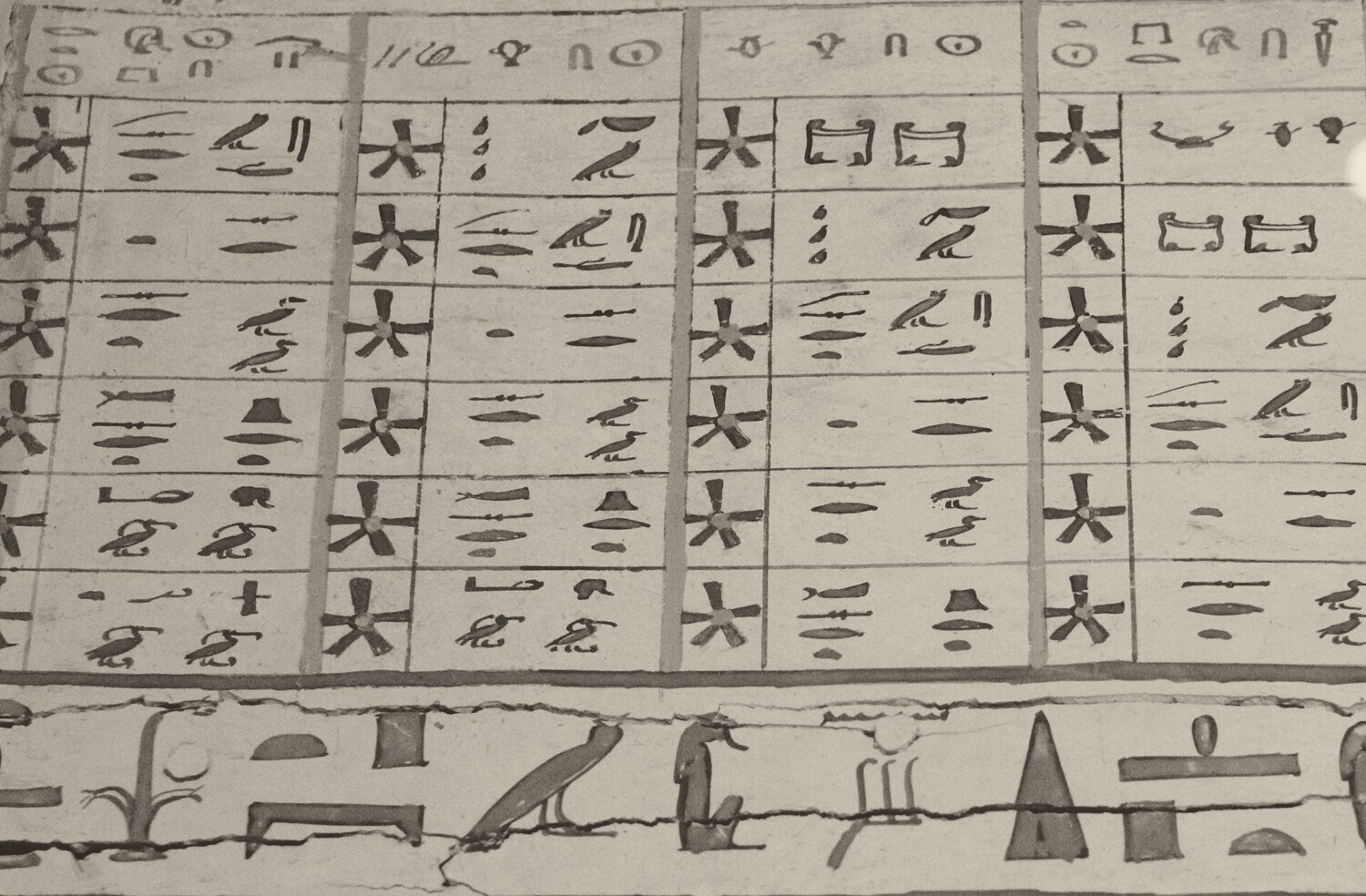
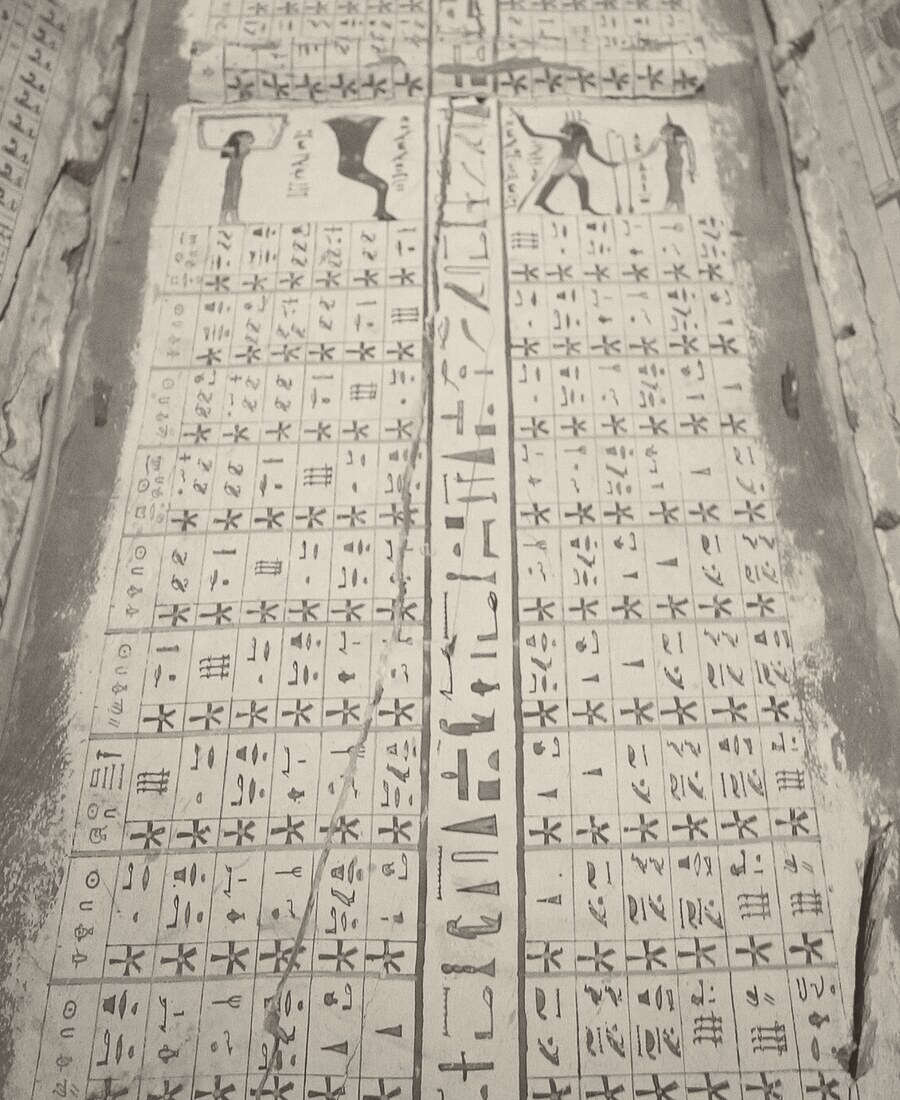
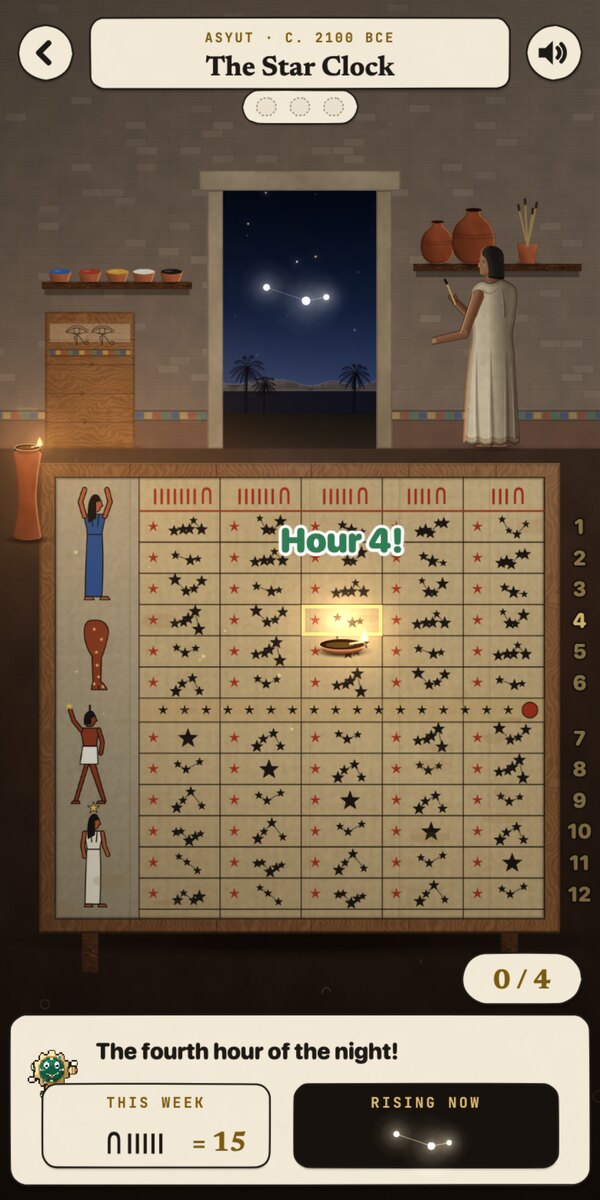
Around 2100 BCE, in the workshop of a coffin-maker at Asyut in Middle Egypt, an artisan painted the underside of a wooden coffin lid with a grid of small boxes: columns for each ten-day week of the Egyptian year, and twelve rows for the twelve hours of the night. Each box names a decan, a star or small group of stars whose rising in the east marked the start of that hour.
Tables like this are called diagonal star tables today, because each star's name runs across the grid on a slant. They are among the oldest astronomical records in the world. Here is a longer look at where they come from, how the grid works, why it slowly went wrong, and what it may have been for.
A few dozen lids, mostly from one town
Four thousand years ago Asyut, on the west bank of the Nile, was the capital of a province of Upper Egypt, and its local nobility were buried in tombs nearby. When archaeologists opened some of them in the 1890s, they found rectangular wooden coffins with something unusual inside the lid: not plain wood or religious spells, but an ordered table of star names. The first was published in 1900.
In 1960 the historian of science Otto Neugebauer and the Egyptologist Richard Parker gathered the 13 tables then known, twelve on coffin lids and one in a temple, in their Egyptian Astronomical Texts. The count has more than doubled since. Sarah Symons of McMaster University in Canada, who has studied every known example, put it at 27 in 2015, depending on how fragments are counted; the online database she leads now lists 28, all but one from coffins. Most come from Asyut, with single examples from Thebes, Gebelein and Aswan. Symons dates most of them to about 2100 BCE; her database says around 2000 BCE, at the start of the Middle Kingdom.
New ones still turn up. In 2013 Symons and her colleague Robert Cockcroft went to the museum at Mallawi, near Asyut, to record a known table on the coffin of a man called Horhotep. Shining a torch under the propped-up lid, they saw star names painted on a batten, one of the crosspieces that hold a lid's planks together: part of another table, fitted to this coffin by mistake. Weeks later the museum was looted, and the coffin's fate is still listed as unknown.
Reading the grid
The grid reads from right to left. The Egyptian civil year had twelve months of 30 days, each split into three ten-day weeks, so 36 columns cover 360 days, and many lids label them along the top. Each column has twelve boxes, one for each hour of the night, and each box holds a star's name, usually beside a painted star. Because each of these stars heads one ten-day week, they are now called decans, from the Greek word for ten.
Two bands cross the grid. The horizontal one carries an offering prayer to the sun god Re and the gods of the sky. The vertical one shows four figures: Nut, the goddess of the sky; Meskhetyu, the Foreleg of an Ox, the seven stars we call the Plough or Big Dipper; Sah, very probably Orion; and Sopdet, the star Sirius, the brightest in the sky then as now.
After the 36 weeks come four more columns. Three repeat all 36 names in order; the fourth serves the five extra days that brought the year to 365. On the most complete table, a lid now in Cairo, the last two boxes add up the company: “Total of those who are in their places, the gods of the sky, 36.”
Why the names run on a slant
The slant comes from a small mismatch between the Sun and the stars. Measured against the stars, the Earth turns once in about four minutes less than a day by the Sun. So any star rises about four minutes earlier each night, and after ten nights some 40 minutes earlier, about the gap between one decan and the next. The star that opened the second hour in one week opens the first hour in the next, and a new decan climbs into the twelfth. Follow one name from column to column and it steps up a row each time, drawing a diagonal across the table.
Read as a clock, as Neugebauer and Parker read it, the table needed only the date and a view to the east. A viewer had only to spot which decan had just cleared the horizon, find it in the column for the current ten days, and read off the hour.
The five extra days spoiled the pattern. Had the year been exactly 360 days long, the 36 decans would have cycled round for ever. Instead the makers followed twelve extra decans, whose names pile up in a triangle at the left-hand end of the table. For Symons, that awkward triangle is good evidence that the tables come from real watching of the sky, not from a tidy model.
These were not our hours. Stars only show once the sky is dark, and a bright star was not always where one was needed, so the hours told this way would have been shorter than 60 minutes and fairly irregular. What was fixed was the number: by about 2150 BCE, the coffin tables show the night divided into exactly twelve.
A calendar with no leap day
There was a slower problem too. The civil year had 365 days and no leap day, while the Sun's year is almost a quarter of a day longer, so the calendar slipped against the seasons and the stars by about one day every four years. In 40 years that adds up to ten days, and every decan in a table sits a whole column out of place. Egypt was given a leap day only in 238 BCE, under Ptolemy III, and even then not everyone kept it.
The surviving tables fall into two families, which Symons calls T and K, with the same decans several columns apart. Neugebauer and Parker saw the drift at work, a later table updated for a calendar that had slipped, and expected tables in between to turn up. None has, and the gaps between matching decans vary, which a simple drift would not produce. Using planetarium software that winds the sky back four thousand years, Symons finds the differences fit best if one family recorded stars rising in the east and the other stars setting in the west.
Clock, almanac or guide for the dead
What the tables were actually for is less certain. Neugebauer and Parker called them star clocks, and a clock of the night would have mattered to priests: in Egyptian belief the Sun made a dangerous journey through the dark hours, and rituals at the right moments could help it. But these tables were painted where no living priest could consult them, inside a coffin lid.
Symons now reads them less as clocks than as almanacs, records of how the sky behaves through the year. The Egyptians did not think of time as a stream of equal hours; midnight or dawn was a state of the sky. Coffins, like temples and tombs, were model worlds whose lids stood for the sky, and the Pyramid Texts imagine the dead reborn as stars. A grandee of Asyut, she suggests, may have needed the table to find his way as he rose to join the decans. Joanne Conman goes further: she rejects Neugebauer's band of decan stars south of the Sun's path, puts the decans on that path itself, and sees the system as religious first. Most specialists have kept the band.
Which stars the decans were is argued over too. Sirius is certain, and Orion and the Plough are secure; Neugebauer thought it pointless to look for the rest. Most researchers take the decan Khau to be the Pleiades. The “red star of Khentet” shows how hard it gets: Christian Leitz matched it to a star in Scorpius called Wei, while José Lull argues it can only be Antares, the brightest and reddest star in that part of the sky. As Symons and the astrophysicist Elizabeth Tasker put it, if we knew the stars we could deduce how they were watched, and if we knew how they were watched we could guess the stars. We know neither.
After the coffins
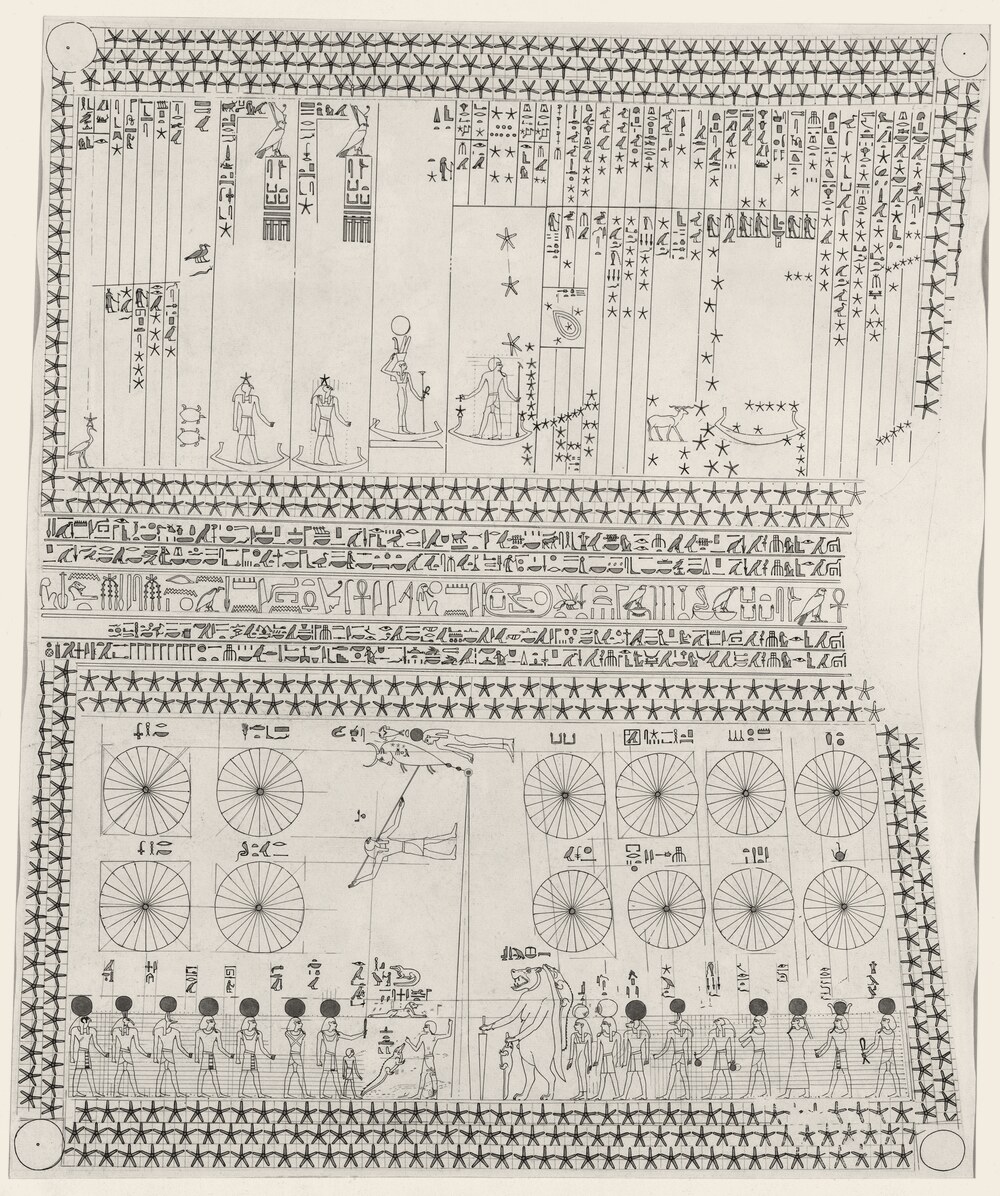
Apart from one later copy, the diagonal tables belong to the early Middle Kingdom, but the decans lived on. The picture at the top of this page comes from about six centuries later: the ceiling of the tomb of Senenmut at Thebes, the oldest surviving Egyptian astronomical diagram, with the decans on its southern half and the northern constellations, the Foreleg among them, on the other.
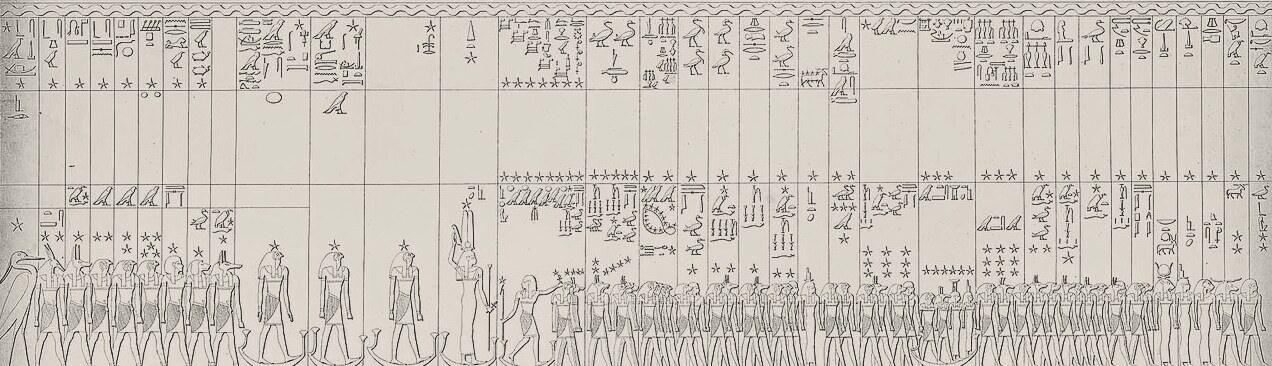
Around 1300 BCE decans crowd the ceiling of the tomb of Seti I. The Osireion at Abydos, begun by Seti and finished by his grandson Merneptah, holds the one diagonal star table not on a coffin, the only one that labels its rows with the names of the hours. It also carries the Book of Nut, whose ancient title is The Fundamentals of the Course of the Stars: the sky goddess arches over the world, swallowing the Sun at evening and giving birth to it at dawn, and she was thought to do the same with the decans. After Merneptah, nothing like a working star clock appears again; at Karnak the priests were already using water clocks.
The decans had one more life. When Greek-speaking astrologers in Egypt took up the zodiac from Babylon, they fitted the decans into it, three to each sign, each covering ten degrees. The Greeks called them dekanoi, tenths, and it is that Greek name, not an Egyptian one, that astrologers still use.
Twelve and twelve
The twelve rows on these lids are one root of the hours on your watch. Egypt also split the daylight into twelve, with shadow clocks and sundials, and, as Michael Lombardi of the US National Institute of Standards and Technology puts it, once both were divided into twelve parts, the 24-hour day was in place. Those hours still stretched and shrank with the seasons; hours of fixed length became commonplace only after mechanical clocks appeared in Europe in the fourteenth century, as in Milan.
The four minutes that put the names on a slant are still with us too. A day measured by the stars, the sidereal day, is about four minutes shorter than a day by the Sun, and observatories long checked their clocks by timing stars across fixed lines in their instruments. A few complicated watches show sidereal time, and a perpetual calendar keeps count of the leap years the Asyut tables never had. Tonight every star will rise about four minutes earlier than last night, and the coffin-maker at Asyut, who painted that step into a grid, would recognise it at once.
.jpg)


