Stop 102 of 109 · Add a Second
1972 · Sèvres, International time
The Night the World's Clocks Counted a Second That Had Never Happened
On 30 June 1972, official clocks everywhere ticked through 23:59:60, an extra second inserted to keep atomic time in step with the turning Earth.
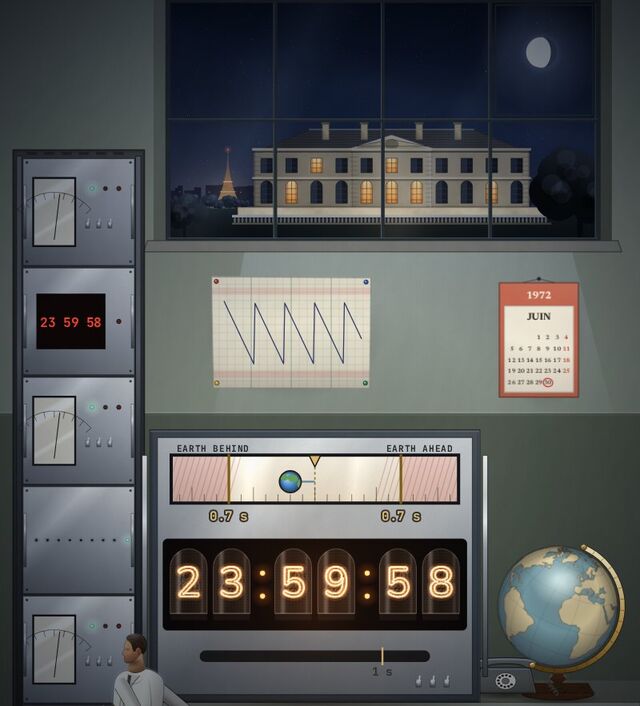
On the night of 30 June 1972, official clocks around the world counted through a second that had never existed before: 23:59:60.
The reason lies in a small mismatch. Coordinated Universal Time is kept by atomic clocks, precise almost beyond imagining, while the Earth's own rotation is not: tidal drag from the Moon lengthens the day by roughly 2.3 milliseconds a century, and the planet's spin wanders a little on its own besides. Left alone, atomic time and the Earth's day would slowly drift apart, and clock noon would stop lining up with the sun overhead.
The leap second is the fix: when the gap grows large enough, an extra second is inserted to bring them back in line. The first one landed at 23:59:60 UTC on 30 June 1972; twenty-seven have followed since, the most recent on 31 December 2016.
They may not continue much longer. In 2022, the world's metrology conference, the international body that sets standards for measurement, voted to widen the allowable gap by 2035. That change is already decided, not merely proposed, and should mean no leap seconds are needed for at least a century afterward.