Stop 40 of 109 · Seven Dials
1364 · Padua, Italy
A Clock That Put the Whole Sky on One Table
Giovanni Dondi spent sixteen years building a machine that tracked the sun, moon and five planets, and it didn't survive to see the modern age.
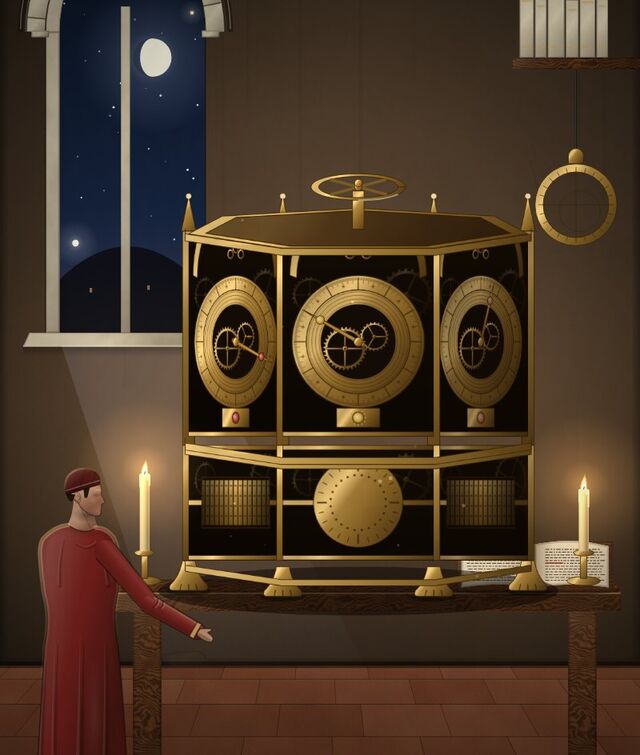
In fourteenth-century Padua, a professor of medicine and astronomy named Giovanni Dondi set out to build a clock unlike any before it. Not content with telling the hour, his Astrarium would show the position of the sun, the moon, and all five planets known to the ancient world, each on its own dial, all driven by a single weight and regulated by a balance wheel, a small wheel that rocks back and forth at a steady rate so the gears beneath it advance in even steps rather than spinning freely. He began in 1348 and finished in 1364: sixteen years, for a machine about a metre tall with 107 moving parts.
The hardest problem was the moon and Mercury, whose apparent speed across the sky isn't constant. Dondi solved it with oval, rather than round, gears, among the earliest recorded uses of non-circular gearing to reproduce an uneven motion mechanically.
It is sometimes said the Astrarium still runs in Padua today. It doesn't: that's a myth. In 1381 it went to the library of Gian Galeazzo Visconti in Pavia, and by some point in the following century and a half it had vanished from the historical record entirely. What survives is Dondi's own book, the Tractatus astrarii, which describes every wheel in enough detail that clockmakers have since built working reconstructions, on display in Milan, at the Smithsonian, and elsewhere.
A moon-phase dial or a perpetual calendar on a modern watch carries a small piece of Dondi's idea: that the sky itself could be put into gears.