Stop 104 of 109 · The Watch That Sets Itself
1990 · Mainflingen, Germany
The Watch That Sets Itself, Listening to a Signal From Frankfurt
Since 1990, watches near a longwave transmitter outside Frankfurt have been able to read the time straight out of the air and set themselves to the second.
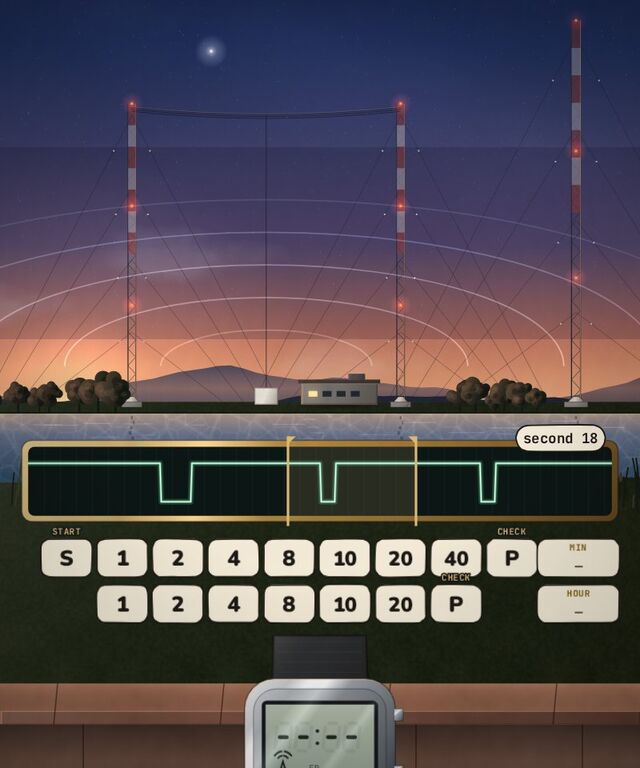
Since 1990, a longwave transmitter near Mainflingen, outside Frankfurt, has been quietly broadcasting the time, and watches built to listen can set themselves, to the second, without anyone touching a crown.
The transmitter, called DCF77, sends a continuous code timed to Germany's national atomic clocks in Braunschweig. Each second, except one, the signal briefly dims: a short dip standing for a zero, a longer one for a one. Fifty-nine of these bits, spread across a minute, spell out the minute, the hour and the date; the fifty-ninth second carries no dip at all, marking exactly where the new minute begins.
The Junghans Mega 1, launched in 1990, was the first watch built to read it: a digital quartz watch with its antenna hidden in the strap, able to set itself and even switch itself for summer time.
The signal's reach is real, if not limitless: about 2,000 kilometres from its masts, enough to cover most of Europe, from Spain to Sweden.