Stop 105 of 109 · Clocks in the Sky
1995 · Colorado Springs, Global Positioning System
The Clocks That Have to Run Slow on Purpose
GPS satellites carry atomic clocks that genuinely run fast in orbit, so engineers deliberately slow them down before launch, exactly as Einstein's physics says they must.
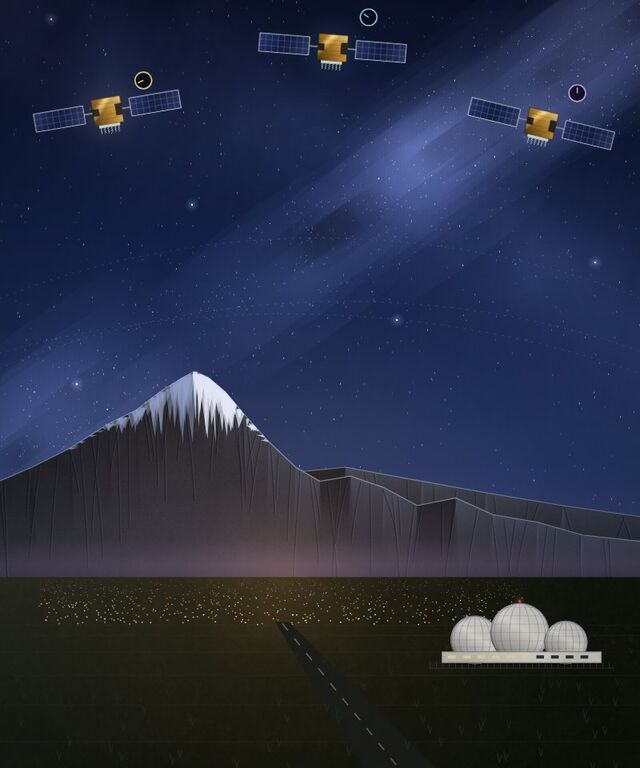
The Global Positioning System reached full strength in 1995, run from a control station near Colorado Springs by a squadron that has overseen the satellite constellation since 1987.
Each satellite finds your location the same simple way: timing exactly how long its radio signal took to reach you, which gives a distance; three or more such distances, taken together, pin down a single point.
That timing has to be extraordinarily precise, and it runs into a real complication from relativity, Einstein's finding that gravity and motion both change how fast time passes for a given clock. Moving fast, each satellite's clock should lose about 7.2 millionths of a second a day; sitting in the weaker gravity of orbit, it should gain around 45.8 millionths, a net gain of roughly 38.6 millionths of a second daily. Left uncorrected, a rough textbook estimate puts the resulting drift at around 11 kilometres a day, though real receivers would absorb part of that error, so the figure is a simplification rather than an exact one.
So before every satellite launches, engineers deliberately tune its clock to run very slightly slow, just enough that, once in orbit, it keeps the same time as clocks on the ground. GPS works only because Einstein's physics was taken seriously and built in from the start.