Stop 19 of 109 · Call the Noon
263 BCE · Rome, Roman Forum
The Sundial Rome Followed for 99 Years, and Got It Wrong
A war-trophy sundial gave Rome its public hours for nearly a century, even though its lines never matched the sun.
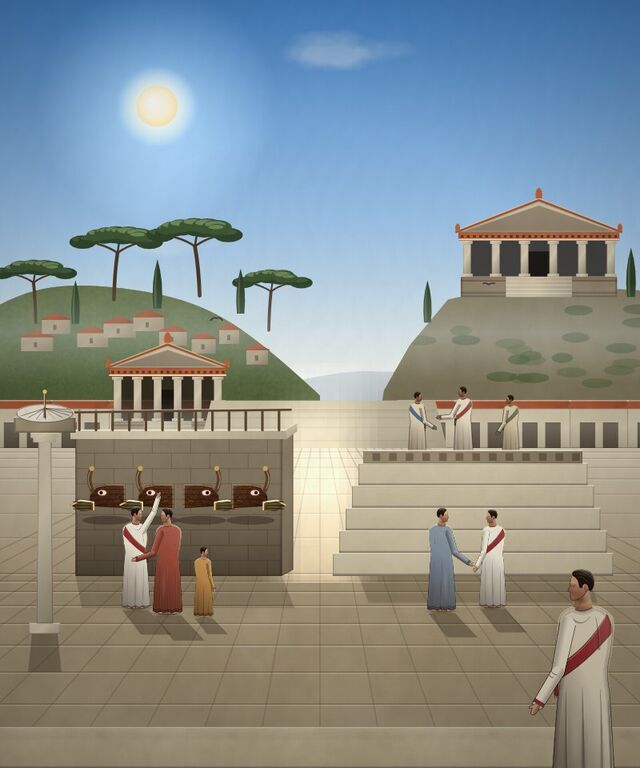
Before Rome had any public clock, the day was marked by only two certainties: sunrise and sunset. For everything in between, a consul's attendant stood in the Forum and watched the sky, announcing noon the moment the sun stood in the gap between the speakers' platform, the Rostra, and the raised stand opposite it where foreign envoys waited.
In 263 BCE, that changed. A Roman general brought home a sundial seized as war booty from Catania, in Sicily, and it was set up near the Rostra as the city's first public timepiece. There was just one problem: a sundial's hour lines are cut for the latitude where it will stand. Carried more than 500 miles north, this one's lines no longer matched the sun overhead.
According to the elder Pliny, Rome consulted it anyway, for 99 years. Only in 164 BCE did a censor, a senior magistrate in charge of public works, finally commission a dial built for Rome's own latitude.
Pliny's account is really all that survives; he doesn't explain why nobody noticed sooner, and the idea that the dial was originally made for Catania is a modern inference from where it was captured, not something he states outright. What's well established is simpler and stranger: a wrong clock stood in Rome's most important public square for nearly a century, quietly misleading a city that had otherwise learned to run its day by the sun.
A modern watch doesn't have this problem. It counts its own beats rather than reading sunlight, so it keeps the same time regardless of where on earth it's worn.