Stop 18 of 109 · Keep It Level
c. 270 BCE · Alexandria, Ptolemaic Egypt
The Clock That Regulated Itself
An inventor in ancient Alexandria solved a basic flaw in the water clock with a simple floating cone: the result is what many call the first self-correcting machine in history.
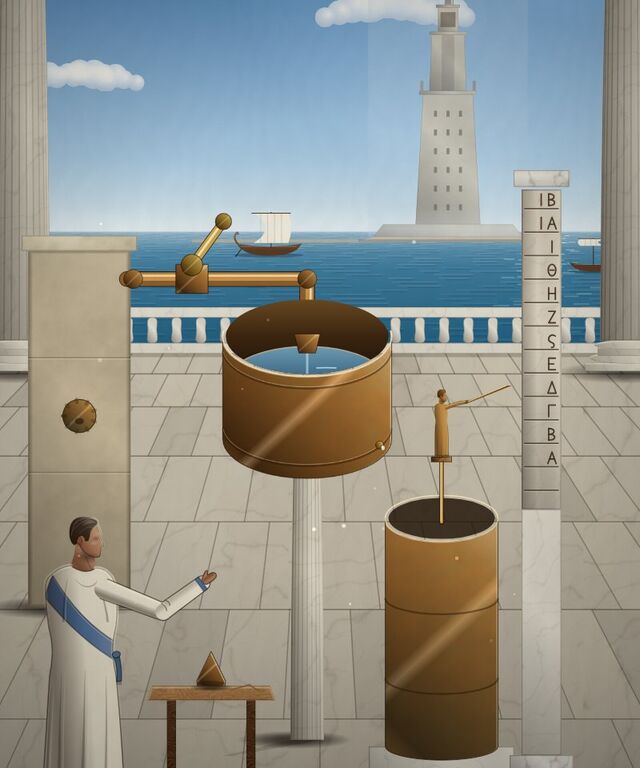
Ctesibius, a barber's son born in Alexandria and probably the first head of its famed Museum, a state-funded research institute rather than a building of exhibits, spent his career improving mechanical devices, and around 270 BCE he turned his attention to a stubborn problem in water clocks. Water dripped from a hole, often bored through gold so it would not wear wider over years of use, and the drips filled a vessel, where a rising float lifted a small pointer to mark the hour.
The flaw was basic hydraulics: a fuller supply tank pushes water out faster than a nearly empty one, so as the day wore on and the tank drained, the clock's drip rate slowed, and its hours grew steadily inaccurate.
Ctesibius's fix was an elegant piece of plumbing: a floating cone sitting in the supply tank that rose with the water level and gradually plugged the inflow pipe as it did, holding the tank's level, and therefore its drip rate, essentially constant without anyone adjusting it by hand.
Ctesibius's own writings did not survive; everything known about his clock comes from later writers such as Vitruvius, so the valve's exact original form is a careful reconstruction rather than a certainty. Still, historians of technology usually credit it as the earliest known example of a self-regulating, feedback-controlled machine, a lineage that runs from a bronze cone in Ptolemaic Egypt to the balance wheel steadying the mainspring in a mechanical watch today.