Stop 9 of 109 · Frame the Sun
c. 2500 BCE · Stonehenge, Wiltshire
The Stones Did Not All Come From Wales
Stonehenge's ring is famous for framing the sun at midsummer and midwinter, and for a long-told story about its stones that turned out to be only half true.
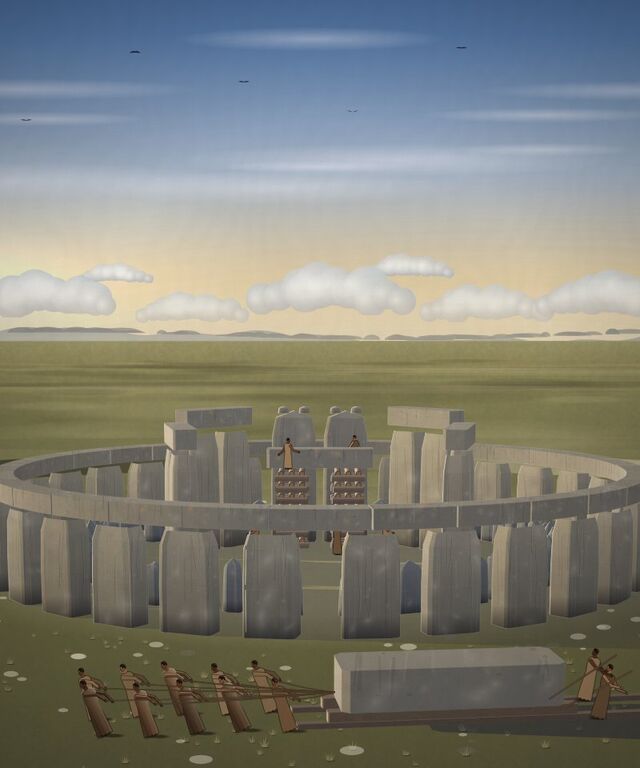
By around 2500 BCE, builders on Salisbury Plain were raising Stonehenge's largest stones: a ring of upright sarsens, each about 25 tonnes, capped by a continuous ring of lintels, with a horseshoe of five taller trilithons, pairs of uprights joined by their own single lintel, at the centre. For a long time, popular accounts held that all of Stonehenge's stones travelled from Wales. That is only true of the smaller bluestones, hauled some 225 kilometres from the Preseli Hills. A 2020 study traced the giant sarsens to West Woods, a much shorter 25 kilometres north of the site itself.
The stones fit together like carpentry: raised knobs, called tenons, slot into hollows cut into the lintels above them, the same joint a woodworker might use, translated into stone. Exactly how Neolithic builders lifted lintels weighing several tonnes onto uprights four metres tall is not known; timber platforms and levers are the leading guess, not a documented method.
The whole arrangement is tuned to the turning points of the year. At midwinter, seen along the monument's axis, the sun sets in the gap of the tallest trilithon. At midsummer, seen from the centre, it rises just to the left of the outlying Heel Stone.
Stonehenge has been rebuilt, reinterpreted and mythologised for centuries. The most reliable thing about it may be the plainest: it still marks the same two sunrises and sunsets it was built to mark, four and a half thousand years ago.