Stop 77 of 109 · Find Easter
1843 · Strasbourg, Cathedral of Notre-Dame
The Clock That Calculates Easter by Itself
Inside Strasbourg Cathedral, a clock finished in 1843 works out the date of Easter each New Year's Eve, using a mechanism nobody has to reset by hand.
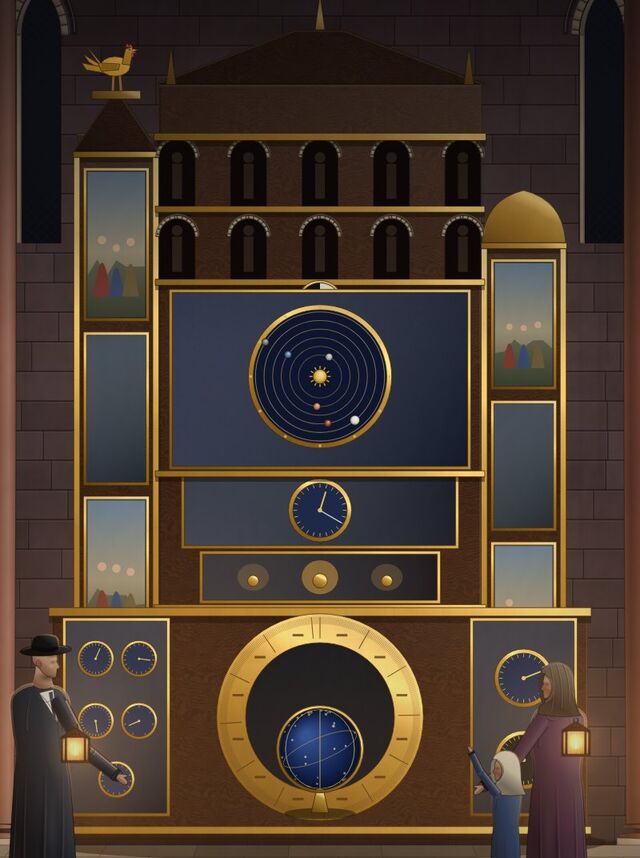
Easter moves. Unlike Christmas, fixed to a date, Easter is pegged to the moon: the first Sunday after the first full moon on or after March 21. That makes it awkward for any clock to track, flipping between March and April year after year, according to a centuries-old church rule.
Jean-Baptiste Schwilgué, a self-taught engineer from Strasbourg, solved it in gears. Between 1838 and 1843 he built a new mechanism for the cathedral's astronomical clock, housed inside its ornate 16th-century case. At its heart is a device called a computus: a mechanism that, at midnight on New Year's Eve, works out Easter and the other movable feasts for the coming year, genuinely calculating them, not just displaying a preset date, based on the church's rules for the moon and for Sundays.
It is very likely the first mechanical device to do this automatically, and it still runs. The clock's face shows the solar cycle, the golden number, and other arcane figures astronomers and clergy once tracked by hand; the computus quietly reconciles them all.
The idea lives on, in miniature, on plenty of modern watches. A perpetual calendar complication (the kind that tracks leap years and knows that April has thirty days without being told) is doing, on a much smaller scale, exactly what Schwilgué's gears worked out for Strasbourg nearly two centuries ago.