Stop 75 of 109 · Watch the Ball Drop
1833 · Greenwich, River Thames
The Ball That Told a Thousand Ships the Hour
Every day since 1833, a red ball has dropped from a mast above the Thames at exactly one o'clock, not noon, so sailors could set their clocks to the second.
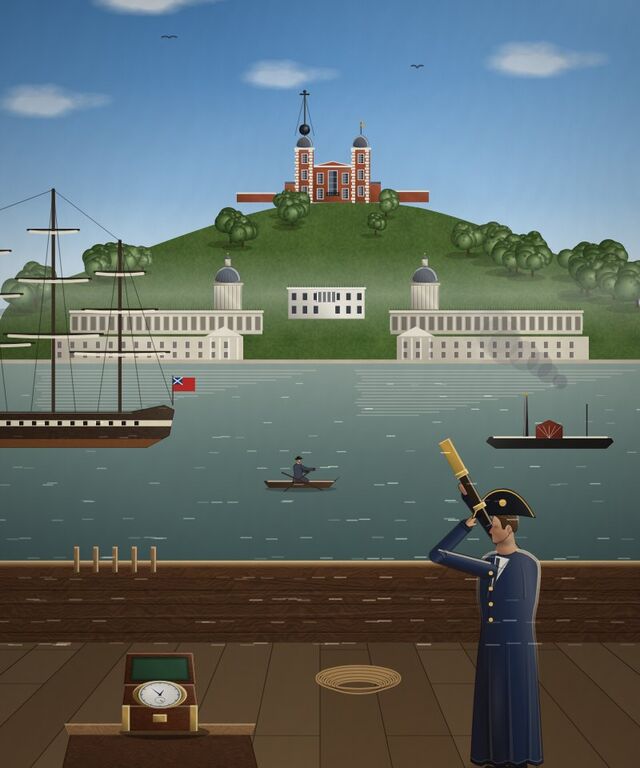
High on a turret of the Royal Observatory in Greenwich, a large red ball still rises up its mast each day, just as it has since 1833. At five minutes to one it climbs halfway; at two minutes to, all the way to the top. Then, at one o'clock exactly, it drops.
Ships anchored in the Thames watched for it. A captain who caught the instant the ball began to fall could set his marine chronometer, the unusually precise clock carried aboard ship, to the second. An accurate chronometer, checked against a known time, let him work out his ship's longitude, its position east or west, by comparing local time to the time back in Greenwich.
Why one o'clock, and not the more obvious noon? The accepted explanation is a simple scheduling conflict: at midday, the Observatory's astronomers were busy tracking the sun as it crossed their telescopes, the actual work of keeping Greenwich time. The public signal had to wait its turn.
One detail mattered as much as the timing: the ball's fall takes several seconds, so an 1844 notice warned sailors to watch for the moment it left the top of the mast, not when it hit bottom. Today's radio-controlled watches, which quietly reset themselves from a distant time signal, solve the same problem the time ball solved. Nobody has to watch the sky for it anymore.