Stop 74 of 109 · Race Against Ink
1821 · Paris, Champ-de-Mars
The Watch That Wrote Its Own Time in Ink
At a Paris horse race in 1821, a jeweller built a timer that marked the seconds by dropping ink on a spinning dial, and gave the chronograph its name.
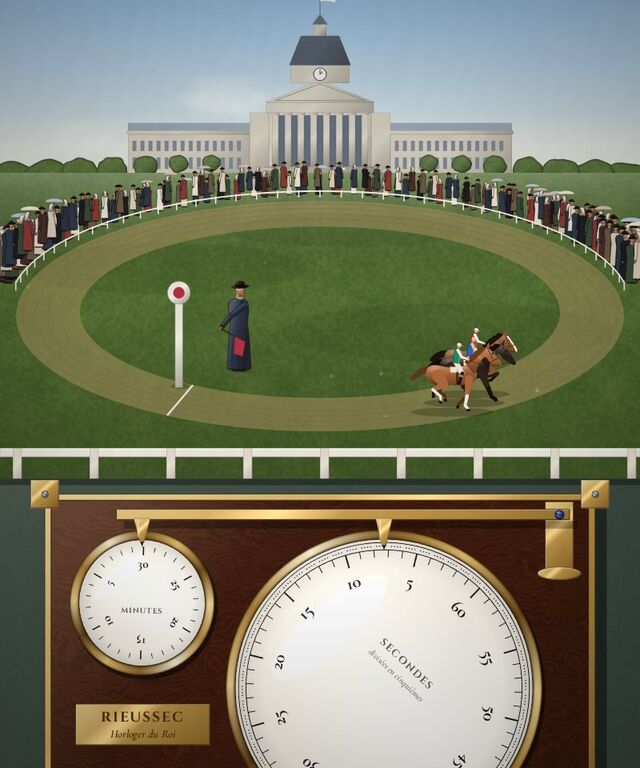
On a September afternoon in 1821, Nicolas Rieussec, watchmaker to King Louis XVIII, set up an odd-looking box at the racecourse on the Champ-de-Mars in Paris. Inside was a clock; on top, two enamel dials turned steadily beneath fixed pens. Press a lever, and a pen dropped a spot of ink onto the turning dial: once at the start of a race, once as each horse crossed the line.
The gap between ink spots, read off the dial like a ruler, gave the time. The French Academy of Sciences was impressed enough to give the device a name that stuck: chronograph, from the Greek for "time" and "writer."
Rieussec is often called the chronograph's inventor, but the claim is genuinely disputed. In 2012, a similar instrument built five years earlier, in 1816, by another watchmaker, Louis Moinet, turned up at auction. Moinet's device, a "compteur de tierces," or third-counter, could measure finer intervals than Rieussec's, but it was likely built for astronomers rather than racegoers, and its rediscovery came long after Rieussec's public reputation was set.
Either way, the idea outlived the ink. Every chronograph today, with its start-and-stop pushers on the side of the case, descends from these two early "time writers," and still carries the name one of them gave it two centuries ago.