Stop 24 of 109 · Sink the Bowl
c. 500 CE · Ujjain, India
The Copper Bowl That Measured Time by Sinking
In ancient Ujjain, a bowl with a single tiny hole kept the palace's hours, sinking every 24 minutes, day and night, without fail.
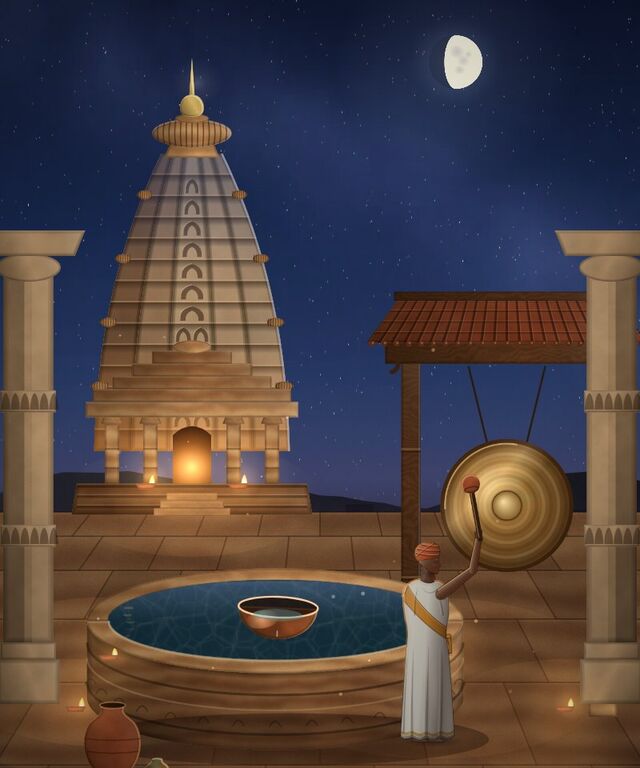
Long before mechanical clocks reached India, the ghaṭī-yantra did the job: a copper bowl, pierced through the bottom with one needle-fine hole, set floating on a larger vessel of water. Water seeped in steadily until the bowl filled and sank, an event called one ghaṭikā, about 24 minutes.
Sixty ghaṭikās made up a full day and night, an echo of the 60-part divisions still used in a modern hour of minutes. Someone had to watch it happen, over and over, through every hour of the day and night: each time the bowl went under, the timekeeper struck a gong, and the whole palace knew.
The day and night were also each split into four longer watches, called pahars, of roughly three hours, seven and a half ghaṭikās apiece. That division survives directly in modern Hindi: dopahar, meaning midday, literally means "two watches," two pahars after sunrise.
It's a simple mechanism built on one fixed principle: let a measured amount of something, water in this case, escape at an even rate, and count the intervals. A mechanical watch runs on exactly the same logic, just with a coiled spring releasing its energy in tiny, regular steps instead of water sinking a bowl.