Stop 25 of 109 · Ring the Hours
c. 530 CE · Monte Cassino, Italy
Why Monks Prayed Eight Times a Day, Even at Night
Benedict's sixth-century Rule set a mountaintop monastery on a schedule with no clock at all, and left behind words still used for parts of the day.
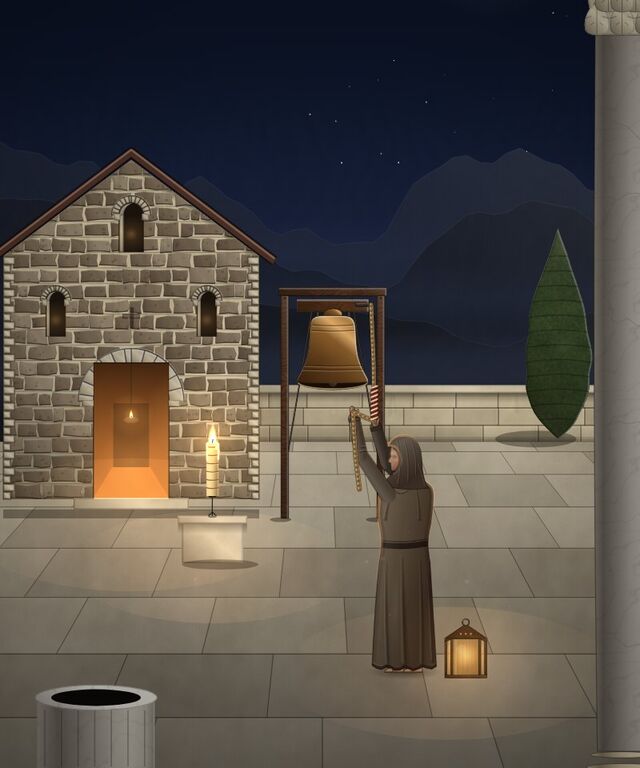
At the monastery of Monte Cassino, founded around 529 on the site of an old temple of Apollo, Benedict wrote a Rule that gave his monks eight fixed times to pray each day: seven through the daylight hours, and one, Vigils, in the middle of the night.
There was no clock to announce them. That fell to the abbot, or to a brother he trusted, who read the sun by day and, after dark, perhaps the stars or a burning candle. When the moment came, someone rang a bell on a rope to call the rest.
The names of those hours still echo in everyday language. None, the ninth hour after sunrise (roughly three in the afternoon), drifted over the following centuries until it simply became "noon." And Sext, the sixth hour, midday, gave us siesta, the rest that follows it.
No mechanical clock existed yet to make any of this easier. But a monastery that needed to know the hour reliably, all day and through the night, was exactly the kind of pressure that helped push medieval Europe toward inventing one. A watch on the wrist still answers the same plain question those monks asked with a rope and a bell: what hour is it now?