Stop 26 of 109 · Spot the New Moon
c. 638 CE · Medina, Arabia
Why Ramadan Never Falls on the Same Day Twice
The Islamic calendar follows only the moon, so its year runs shorter than the sun's, and its holiest month drifts slowly through every season in turn.
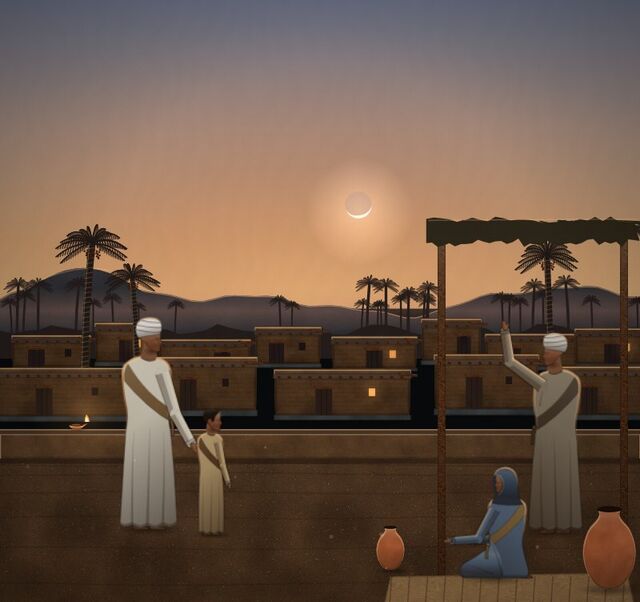
At dusk in Medina, in the early decades of Islam, families would climb onto their flat rooftops and look west, searching the fading light for the hilāl, the first thin sliver of a new crescent moon. If it was seen, a new month began that evening. If not, the current month simply ran to 30 days and the search resumed the next dusk.
Twelve of these lunar months make a year of about 354 or 355 days, roughly 11 days shorter than a year measured by the sun. Around 638 CE, the caliph ʿUmar fixed the calendar's starting point to the Hijra, the Prophet's move from Mecca to Medina in 622, giving the reckoning still used today.
Because the lunar year runs short, a month like Ramadan doesn't stay fixed the way a birthday does. Each year it begins about 11 days earlier than the last, sliding gradually backward through the solar seasons, from summer to spring to winter, before returning to roughly where it started every 33 years or so.
No table decides any of this far in advance; the sighting itself, or the calculated completion of 30 days, settles each month one at a time. A moonphase watch, ticking through the same 29-and-a-half-day cycle on its dial, keeps company with a tradition that has tracked the same moon for well over a thousand years.