Stop 98 of 109 · Fourteen Seconds
1970 · Apollo 13, Between Earth and the Moon
Fourteen Seconds, Timed on a Wrist, That Brought Three Men Home
With Apollo 13's computer shut down to save power, the crew aimed their crippled spacecraft at Earth using a chronograph and the line between day and night.
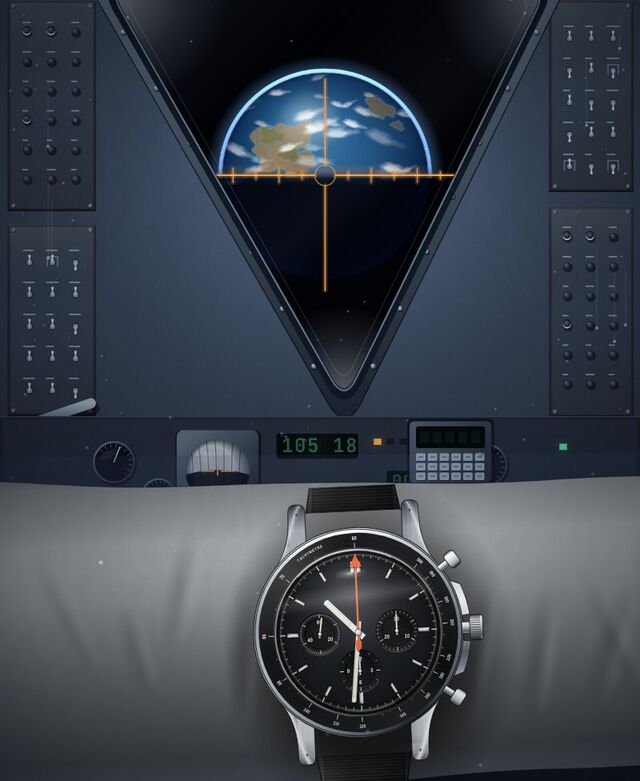
On the way to the Moon in April 1970, an oxygen tank aboard Apollo 13 failed, and the crew moved into the lunar module Aquarius as a cramped, powered-down lifeboat, the cabin eventually dropping to around 3 degrees Celsius.
To correct their course home, they needed to fire the descent engine by hand for what mission control's burn instructions called 14 seconds. With the guidance computer shut off to save power, there was no automatic way to aim. Instead, astronauts Jim Lovell and Fred Haise held the spacecraft steady by eye, keeping Earth's terminator, the line where day meets night, centered in a simple sighting device on the window, while Jack Swigert used the chronograph on his wrist, a watch with a built-in stopwatch function, to time the burn, with Houston counting down alongside him.
"We used the watch that Jack had on his wrist," Lovell said afterward. It was enough: the burn worked, and the crew splashed down safely on 17 April 1970.
One thing worth correcting here: it's sometimes claimed that only one kind of watch has ever been worn on the Moon. That's a myth. On Apollo 15's third moonwalk, in 1971, astronaut Dave Scott wore a Bulova chronograph on the lunar surface, as a backup to his standard-issue watch, not a replacement for it.