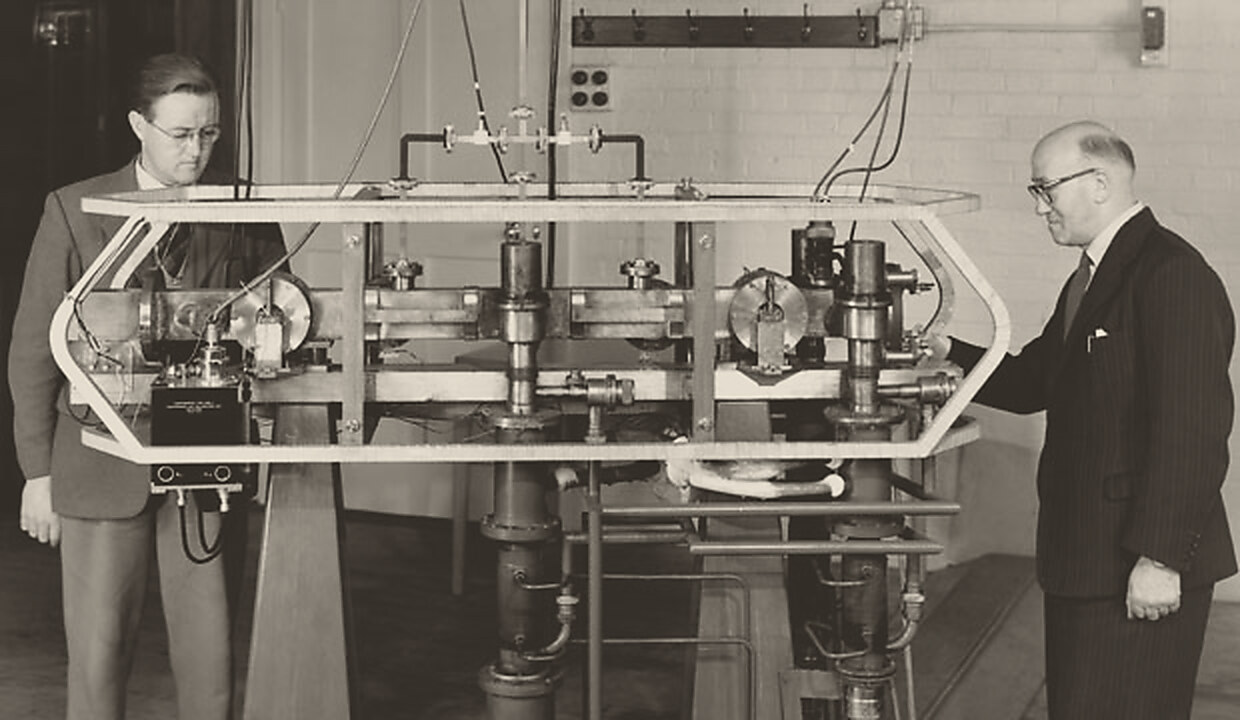
The first practical atomic clock, National Physical Laboratory, Teddington, 1955, with Jack Parry (left) and Louis Essen. Photo: National Physical Laboratory, public domain, via Wikimedia Commons. Enlarged and toned for this page.
Stop 99 of 109 · Find the Resonance · 7 min read
1955 · Teddington, National Physical Laboratory
Where the Second Stopped Belonging to the Sky
In 1955, two physicists outside London built a clock that measured time by an atom's own resonance, and the whole world eventually adjusted to match it.
Fact rating: MythFact rating
the myth: "atomic" means radioactive. caesium-133 is a perfectly stable isotope, and nothing in the clock decays.
In 1955, at the National Physical Laboratory in Teddington, outside London, physicists Louis Essen and Jack Parry built the first practical atomic clock. It worked by passing a beam of caesium atoms through a microwave cavity and tuning the microwave frequency until it matched the atoms' own natural resonance exactly.
Until then the second had always belonged to the sky. It was 1/86,400 of an average day, and from 1956 a fraction of the year 1900. Twelve years after the Teddington clock first ran, the world's standards body gave the second to the atom instead, and it has stayed there. Here is a longer look: how the clock worked, what its famous accuracy figure means, how an atom was weighed against the Moon, and why "atomic" has nothing to do with radioactivity.
An idea eighty years early
The idea came long before the machine. In the 1870s James Clerk Maxwell suggested to his childhood friend Peter Guthrie Tait and to William Thomson, later Lord Kelvin, that a vibrating piece of quartz would make a better standard of time than the turning Earth. But a crystal is still "one particular piece of matter", he warned. Atoms would be better. In 1879 Thomson and Tait described atoms of hydrogen or sodium as natural standards "ready made in infinite numbers, all absolutely alike".
In 1937, at Columbia University in New York, Isidor Rabi invented a way to read an atom's natural frequency with a beam of atoms, magnets and radio waves, work that won him the 1944 Nobel Prize. In 1940 his group put caesium's frequency at about 9,191.4 million cycles a second, close to today's number. In January 1945 Rabi spoke in public about atomic clocks, and the New York Times called his idea a "cosmic pendulum".
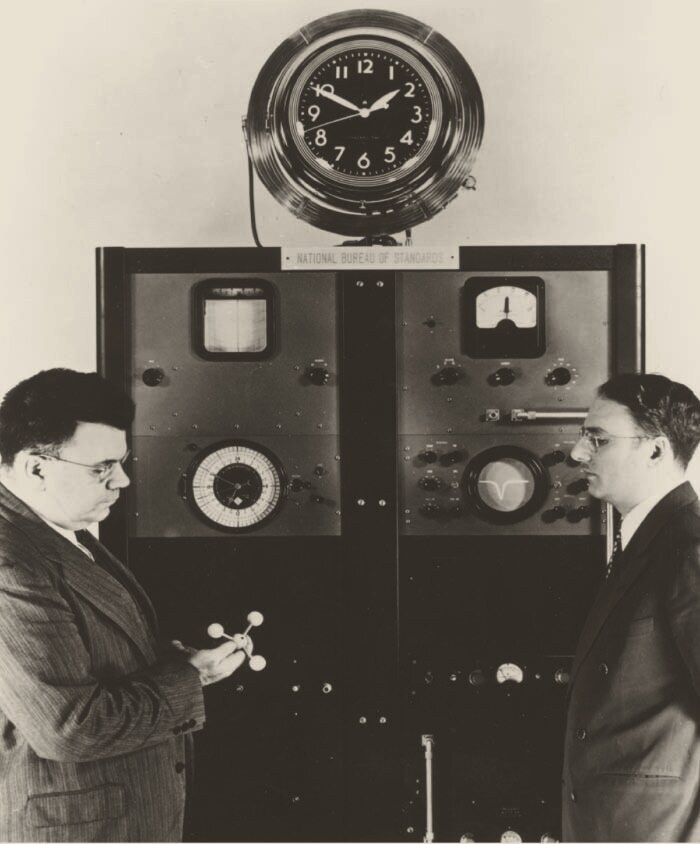
The first atomic clock of any kind was American. At the National Bureau of Standards in Washington, Harold Lyons and his team built one around the ammonia molecule. It first ran on 12 August 1948 and was shown to the public in January 1949. It proved the idea worked, but it was no more accurate than the clocks it was meant to beat. The bureau's first caesium clock had a resonance far too broad for a precise standard, and by 1953 budget cuts and a move to Colorado had stalled the work. That is why the Teddington clock, which came later, is called the first practical one: it was the first atomic clock steady enough to serve as a time standard.
the wall clock was there for show
The first atomic clock of any kind: the ammonia clock at the US National Bureau of Standards, Washington, 1949. Left, the bureau's director Edward Condon with a model of the ammonia molecule; right, its inventor Harold Lyons. Photo: National Bureau of Standards (now NIST), public domain, toned, via Wikimedia Commons.
Two years in Teddington
Louis Essen had joined the National Physical Laboratory in 1929 and made his name with quartz clocks steady enough for observatories, Greenwich among them. From 1949 he visited American laboratories, meeting Rabi and Jerrold Zacharias of MIT, and became convinced that caesium would beat ammonia. Work at Teddington began in 1953, the same year the American effort all but stopped. His partner was Jack Parry, a microwave specialist. The clock first worked on 24 May 1955, and by June it was in service as a working time standard.
The principle is simple to say. Caesium is heated at one end of a long vacuum tube, and a thin beam of hot atoms flies down it. Each atom can sit in one of two slightly different energy states, and microwaves of exactly the right frequency will flip it from one to the other. Essen's beam passed through two microwave fields nearly 50 centimetres apart, a method invented in 1949 by Norman Ramsey at Harvard, which makes the resonance far sharper. At the far end, a detector measured how many atoms had flipped.
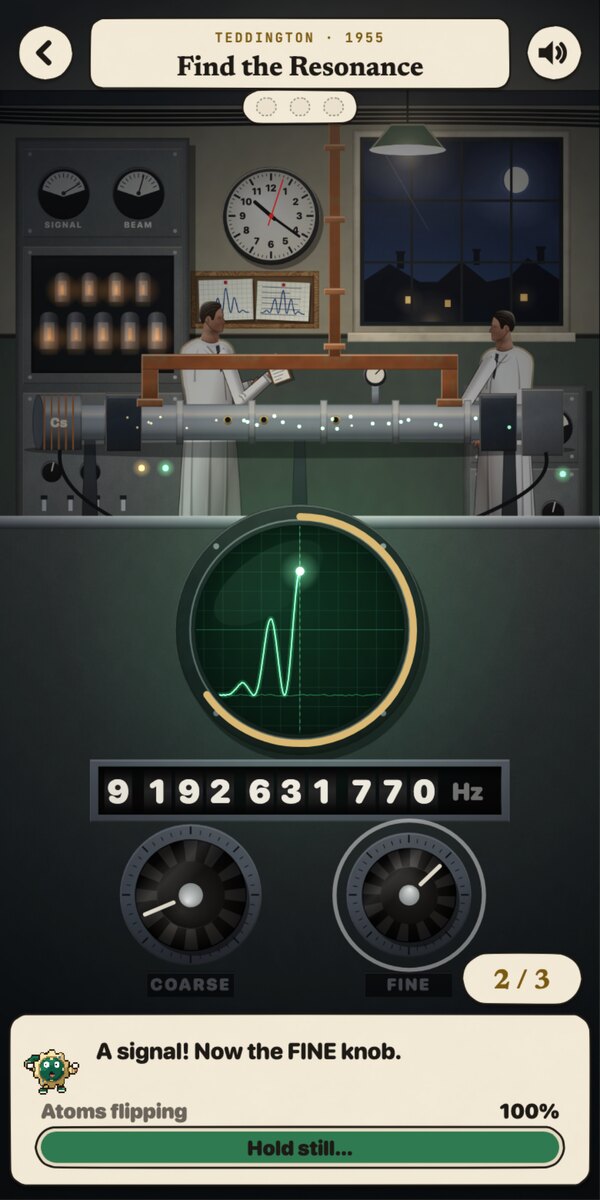
Then you tune. Sweep the microwave frequency and, far from the right value, little happens. Close to it, the signal rises through small side peaks, called Ramsey fringes, and at one frequency it reaches a single tall peak: the atoms' own resonance. Hold the microwaves there, and nature, not a craftsman, sets the frequency. The Teddington resonance was just 340 cycles a second wide, out of more than nine billion.
tune the microwave frequency...
...until it matches the atoms' own resonance exactly
once locked: about one second in 300 years, by the usual account
Drawing, not to scale. The atoms answer most strongly at one frequency; the smaller peaks either side are the ones to pass by. The first published figure was looser, about a second in 30 years.
Strictly, it was not yet a clock: it did not run all the time, and every few days it was used to check the quartz clocks that did the timekeeping. But it was a far more regular timekeeper than the Earth itself. Essen later wrote that he invited the laboratory's director "to come and witness the death of the astronomical second and the birth of atomic time." The clock itself is now in the Science Museum in London.
One second in how many years?
Most accounts say the clock was accurate to about one second in 300 years. The figure is everywhere. The Science Museum's text for the clock gives it, and NPL's Helen Margolis puts the original clock at about one part in ten thousand million, which is the same thing. But NIST's historian Michael Lombardi gives its original reported accuracy as one part in a billion, ten times looser: about a second in 30 years. The Linda Hall Library also says 30.
Why the gap? We could not read the 1955 paper in Nature, which is behind a paywall. What we can say is that the first figures tied the atom to the astronomers' second, which was itself uncertain. In June 1955 Essen and Parry put caesium at 9,192,631,830 cycles a second, give or take 10, against a second taken from the Royal Greenwich Observatory's measurements of the sky: about one part in a billion. By 1958 the clock itself was considered good to five parts in ten thousand million. The fairest reading: 30 years is closer to what was first claimed in print; 300 years is the figure that stuck, and caesium clocks passed it within a few years. The note on the drawing above keeps the usual figure, with this warning attached.
Weighing the atom against the Moon
A steady clock was not enough: the new second had to match the old one, and the old one had just changed. In 1956 the second was redefined as 1/31,556,925.9747 of the tropical year 1900, the "ephemeris second", which could only be found by watching the Moon move against the stars, for years. Essen was scathing: "Even scientific bodies can make ridiculous decisions."
So from mid-1955 to early 1958, NPL worked with William Markowitz of the US Naval Observatory in Washington, who photographed the Moon with a camera of his own design. The two laboratories compared clocks across the Atlantic by timing the same radio signals. In August 1958 Markowitz, R. G. Hall, Essen and Parry published the answer: 9,192,631,770 cycles of caesium in one ephemeris second, give or take 20, about two parts in a billion. The uncertainty came from the astronomy, not the atom.
Hopes for Ramsey's hydrogen maser held the decision up for a few years, but in October 1967 the 13th General Conference on Weights and Measures defined the second as "the duration of 9 192 631 770 periods of the radiation corresponding to the transition between the two hyperfine levels of the ground state of the caesium 133 atom". The number is the 1958 measurement, unchanged.
since 1967: exactly 9,192,631,770 vibrations of a caesium-133 atom
Drawing, not to scale: the wave is broken in the middle. A second holds nine billion of these.
The wording has been polished since: since 20 May 2019 the second is defined by fixing the caesium frequency at exactly 9,192,631,770 hertz. The second itself has not moved. One thing the 1958 match did carry forward: the ephemeris second was already slightly shorter than the second of the Earth's actual turning, so the Earth falls slowly behind atomic time, and since 1972 leap seconds have been added to keep the two in step.
Atomic, not radioactive
Now the myth this stop is rated for. "Atomic" does not mean radioactive. Caesium-133, the atom in every caesium clock, is stable: it does not decay. It is also the only caesium found in nature; the international commission on atomic weights lists caesium as an element with a single isotope. The radioactive caesium in the news after nuclear accidents is caesium-137, a different isotope made by nuclear fission in reactors and bombs.
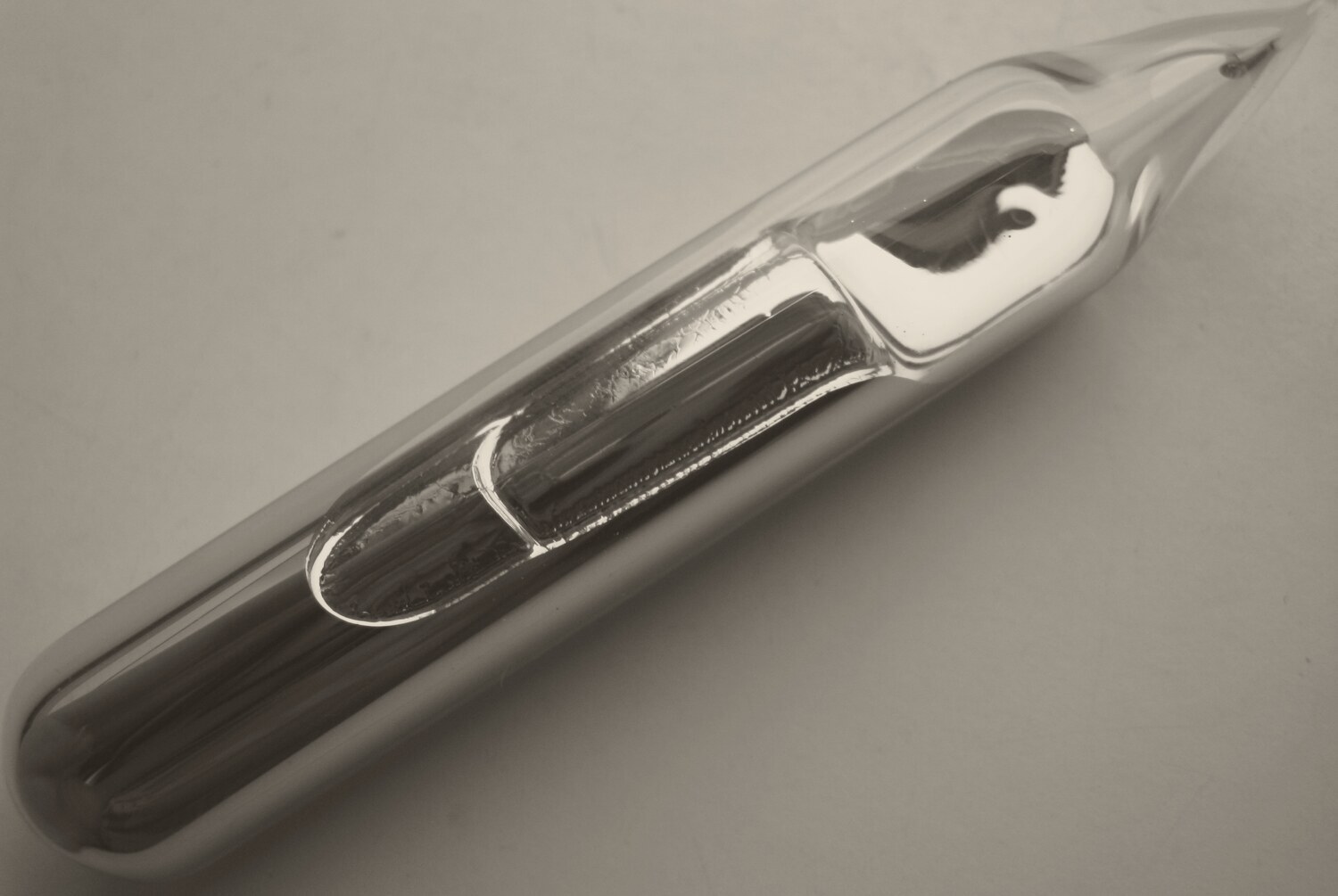
In the clock, nothing is split and nothing decays. "Atomic" refers to the atom's energy levels. The nucleus of a caesium atom behaves like a tiny magnet, and so does its outer electron; the two can sit in two slightly different arrangements, the "two hyperfine levels" of the definition. The clock only nudges atoms from one arrangement to the other and counts them. Caesium itself is a soft, pale gold metal that melts at about 28 °C and catches fire in air, so it is stored in sealed glass ampoules.
stable caesium-133: nothing here decays
Caesium metal, sealed in a glass ampoule. All natural caesium is caesium-133, the stable isotope that defines the second. In colour it is a pale gold. Photo: Dnn87, CC BY-SA 3.0, cropped and toned; this print is shared under the same licence, via Wikimedia Commons.
From a beam to a fountain to light
Teddington's lead was brief. The first commercial caesium clock, the Atomichron, from a team led by Zacharias, appeared in October 1956. Zacharias had also imagined a better trick in the 1950s: toss the atoms upwards and let them fall back, so the microwaves can watch them for longer. Lasers that slow atoms almost to a standstill made it work, and by 1999 caesium "fountains" were keeping time in France, the United States and Germany.
Teddington still works this way. NPL runs two caesium fountains, NPL-CsF2 and NPL-CsF3, in which laser light pushes a cloud of slow caesium atoms upwards through the microwaves. They steer the UK's time scale, UTC(NPL), and feed the world's. Since 1955 the best caesium standards have improved by a factor of about a million; the uncertainty of NPL-CsF2 was put at 2.3 parts in ten million billion in 2011.
The next step leaves caesium behind. Optical clocks use atoms or ions that answer to light, which packs about 100,000 times as many waves into each second. The best are up to about a hundred times more accurate than caesium, and NPL builds its own, with strontium and ytterbium. A draft resolution for the next General Conference, on 13 to 15 October 2026, admits there is still no agreement on which atom, or which mix of atoms, should take over, and aims for a new definition in 2030, or 2034 if it slips. Whatever is chosen will be matched to the caesium second, just as caesium was matched to the Moon.
From Teddington to your wrist
Your watch does not hold an atom, but its time does. A quartz watch counts the vibrations of a tiny crystal, exactly the kind of standard Maxwell warned would always be one particular piece of matter, and the kind Essen spent his early career perfecting. A phone's time comes through networks and satellites steered by atomic clocks. A radio-controlled watch in Britain listens for MSF, NPL's time signal, broadcast on 60 kHz from Anthorn in Cumbria; its time and date code sets clocks to UK time.
Behind all of it sits Coordinated Universal Time, worked out each month from the clocks of around 70 timing institutes, NPL among them, and kept true to caesium's 9,192,631,770 cycles. The second on your dial stopped belonging to the sky in a laboratory in Teddington. For now it belongs to caesium; before long, it will probably belong to light.
turn the knobs to find the peak
the atoms' own resonance
9,192,631,770 vibrations: one second
A frame from Find the Resonance, chapter 99 of the Grand Tour of Time in WORN.
Chapter 99 · Find the Resonance
Tick, the guide, asks: Since 1967 the second itself belongs to an atom. Which one, and how is it heard?
PaperThe leap second: its history and possible future · Nelson, McCarthy, Malys et al., Metrologia, 2001.How the 1955 to 1958 measurements tied caesium to the astronomers' second, and why leap seconds followed. Free PDF from NIST.
PaperRoadmap towards the redefinition of the second · Dimarcq, Gertsvolf, Mileti et al., Metrologia, 2024.The metrologists' own plan for replacing caesium with optical clocks, options and deadlines included. Open access.
EssayA brief history of timekeeping · Helen Margolis, Physics World, 2018.An NPL physicist on the road from sundials to Essen's beam and on to optical clocks.
EssayA Brief History of Atomic Time · National Institute of Standards and Technology, 2024.The American side of the story, from Kelvin's idea to nuclear clocks, richly illustrated.
EssayLouis Essen: Time lord of precision atomic clocks · Jeff Hecht, SPIE Photonics Focus, 2023.A short life of Essen, from a cobbler's son in Nottingham to the man who retired the astronomical second.
BookRevolutions in Time: the world of Louis Essen, clockmaker and father of atomic time · Ray Essen, 2020.A biography by Essen's son-in-law, drawn from his unpublished memoir.
On this tourLeap second, Radio, GPS, OpticalWhat the caesium second did next: leap seconds, radio time, satellites, and the clocks that may replace it.