Stop 108 of 109 · Time Runs Faster Upstairs
2020 · Tokyo, Tokyo Skytree
The Clock So Precise It Could Feel You Standing Up
In 2020, physicists carried matching clocks up Tokyo Skytree and found that the one 450 metres higher genuinely ran faster, proof that gravity itself bends time.
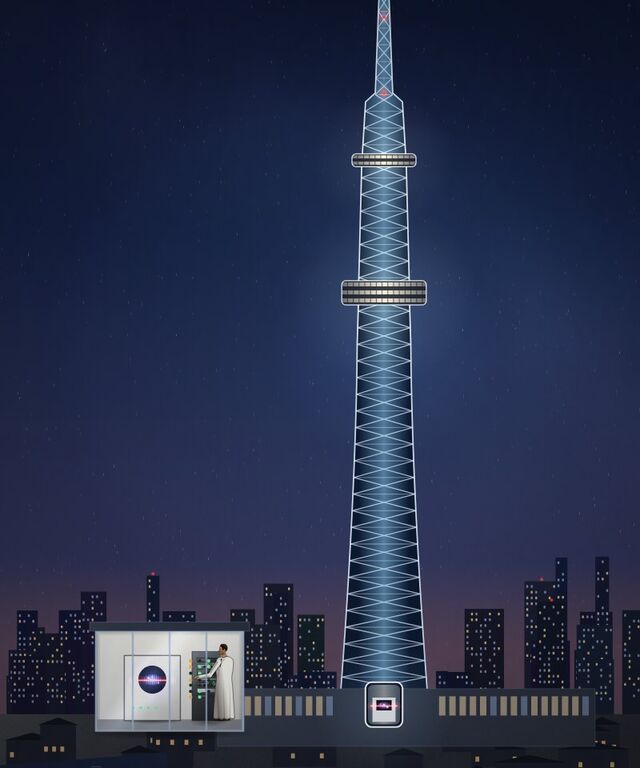
In 2020, a team led by the physicist Hidetoshi Katori, working with RIKEN and the University of Tokyo, carried two matching clocks up Tokyo Skytree to test one of Einstein's stranger predictions: that a clock at higher altitude should run very slightly faster.
The clocks themselves were remarkable: strontium "optical lattice" clocks, holding thousands of atoms motionless in a crisscrossing grid of laser light, like eggs held still in a carton, and measured by a laser pulse ticking about 429 trillion times a second.
One clock stayed at the tower's foot; the other rode up to its 450-metre observation deck. Compared over time, the higher clock really did run faster, gaining about 4.26 billionths of a second every day, exactly in line with general relativity's prediction that gravity, ever so slightly weaker higher up, lets time run a touch quicker.
The comparison confirmed Einstein's prediction to eighteen digits of precision, a feat normally reserved for underground physics laboratories, carried out instead inside an ordinary tourist tower. Clocks this precise, Katori's team has noted, could one day measure differences in height of about a centimetre from timing alone.