Stop 52 of 109 · Ten Days Vanish
1582 · Rome, Papal States
The October That Lost Ten Days
In 1582, much of Europe went to bed on October 4th and woke up on October 15th, a fix for a calendar error thirteen centuries in the making.
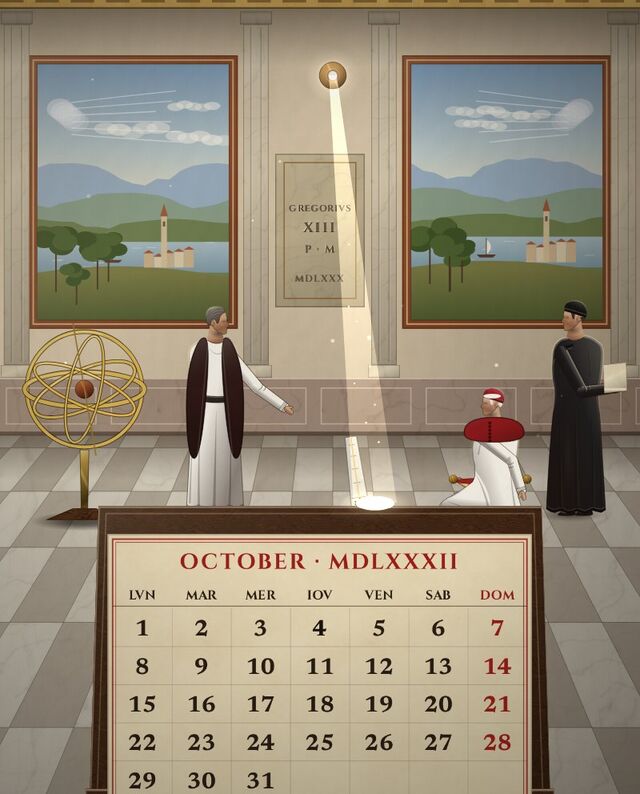
Julius Caesar's calendar counted the year at 365 and a quarter days, about eleven minutes longer than the real solar year. It doesn't sound like much, but over thirteen centuries those minutes added up: by the 1500s, the spring equinox, which the Church anchored to March 21st for calculating Easter, was actually arriving around March 11th.
Pope Gregory XIII's fix, announced in the bull Inter gravissimas in February 1582, was direct: erase ten days outright, and change the leap-year rule so the drift couldn't return. Thursday, October 4th, 1582 was followed by Friday, October 15th (no days of the week were skipped, only dates), and from then on, century years would be leap years only when divisible by 400. That's why 2000 had a February 29th and 1900 did not.
Catholic countries adopted the new calendar almost immediately. Protestant England held out until 1752, by which point the accumulated gap had grown to eleven days, and popular legend says angry crowds rioted in the streets demanding their 'eleven days' back. That story is a myth almost certainly invented after the fact: no riot appears in any record from the time, and it traces mainly to a satirical 1755 painting by William Hogarth, made as a joke about a rigged election, not a real protest.
The Gregorian rule is still the one on the wall calendar, and on most watches with a perpetual calendar complication, a mechanism geared to track the leap-year rule automatically, which is why those watches need a visit from a watchmaker in the year 2100, the next time the 400-year rule skips a leap day that a simpler four-year rule would have kept.