The Grand Tour of Time · Age V · Carrying Time

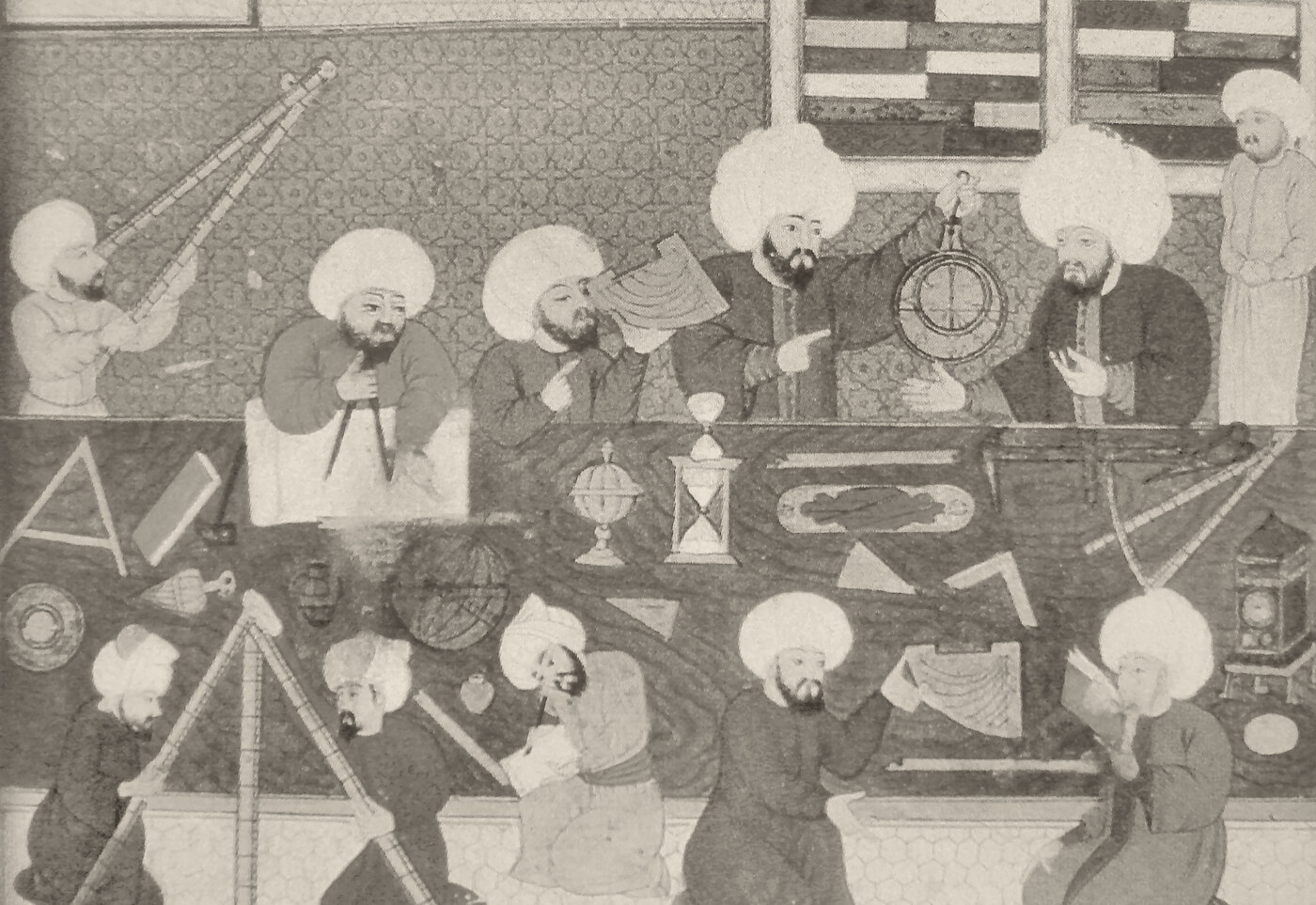
Ottoman miniature of astronomers at work in the Istanbul observatory: turbaned scholars sit and stand around a long table covered with instruments, one sights along a long rod, one holds up a ring of brass, and at the right edge a small clock stands on a stand.
Taqi al-Din's observatory at work, Ottoman miniature, anonymous, from the Sehinsahname. Public domain, via Wikimedia Commons. Cropped and toned for this page.

Stop 51 of 109 · The Clock of Seconds · 7 min read

1577 · Istanbul, Ottoman Empire

The Astronomer Who Needed to Count in Fifths of a Minute

Taqi al-Din built an observatory for the Ottoman sultan with a clock precise enough to time the stars. It lasted only three years.

Fact rating: Established

To time exactly when a star crosses a fixed point in the sky, an astronomer needs more than hours. In 1577, the polymath Taqi al-Din Muhammad ibn Ma'ruf, chief astronomer to the Ottoman sultan, began observing from a new observatory at Tophane, overlooking the harbour of Istanbul, equipped for that kind of precision.

Among its great instruments of brass and wood stood a mechanical clock made for observing. In his own words, he divided each minute on it into five parts, which he called seconds. Here is a longer look at the man, the clock, the comet of 1577 that he read as an omen, and the order that pulled the whole place down in January 1580, which historians still argue about.

A judge who studied clocks

Taqi al-Din was born in Damascus in 1526. His father taught law, and he too trained first in religion and law; for years he taught and served as a judge in Damascus, Cairo and Nablus, while studying mathematics and astronomy alongside. In 1570 he came to Istanbul from Cairo, and in 1571 he was made chief astronomer. The court's astronomers prepared almanacs, chose auspicious hours and advised the ruling elite, so the post mixed astronomy with astrology.

Clocks had fascinated him long before. In the 1550s the statesman Semiz Ali Pasha, governor of Egypt and later grand vizier, let him use his private library and his collection of European mechanical clocks. Such clocks reached Istanbul as diplomatic gifts: the Habsburgs sent them to the sultan, partly to show off European skill, and the Ottomans counted them as tribute. In 1559, while a judge in Nablus, Taqi al-Din wrote The Brightest Stars for the Construction of Mechanical Clocks (al-Kawakib al-durriyya fi wad' al-bankamat al-dawriyya), the first known book on mechanical clocks from the Islamic world.

It sorts the clocks of his day into four kinds: watches, domestic clocks, astronomical clocks and tower clocks. It describes weight-driven clocks regulated by a verge and foliot, a rocking bar with sliding weights that lets the gears advance one tooth at a time, together with striking trains for the hours, an alarm set with a peg, moon-phase and prayer-time displays, and clocks driven by springs, the technology of the first portable watches.

An observatory above Tophane

Taqi al-Din argued that the astronomical tables in use had grown out of date and that only new observations could correct them. Murad III, sultan from late 1574 and keenly interested in astronomy and astrology, agreed; his tutor Hoca Sadeddin and the grand vizier Sokollu Mehmed Pasha backed the plan. Most historians date the start of building to 1575 and its use to 1577, when it was still partly finished, though one encyclopedia entry places the sultan's order as late as early 1579.

It stood on the heights of Tophane, on the European side of the Bosphorus; its exact site is uncertain, and a replica quadrant now stands near Istiklal Avenue. There were two buildings, one large and one small, with a library, and a staff of sixteen by one count: eight observers, four clerks and four assistants.

The big instruments were built as large as possible, so that their scales could show minutes of arc. The historian Sevim Tekeli, who edited the texts that describe them, lists an armillary sphere of six rings (nested metal circles, each tracing a circle of the sky) at least four metres across; a mural quadrant, a brass quarter-circle six metres in radius fixed to a wall on the north-south line, for measuring how high the Sun and stars climb; a wooden quadrant; a frame like a sextant for the distance between two stars; and an instrument with cords for fixing the equinoxes. Most closely match the instruments Tycho Brahe was building at the same time on Hven, in Denmark.
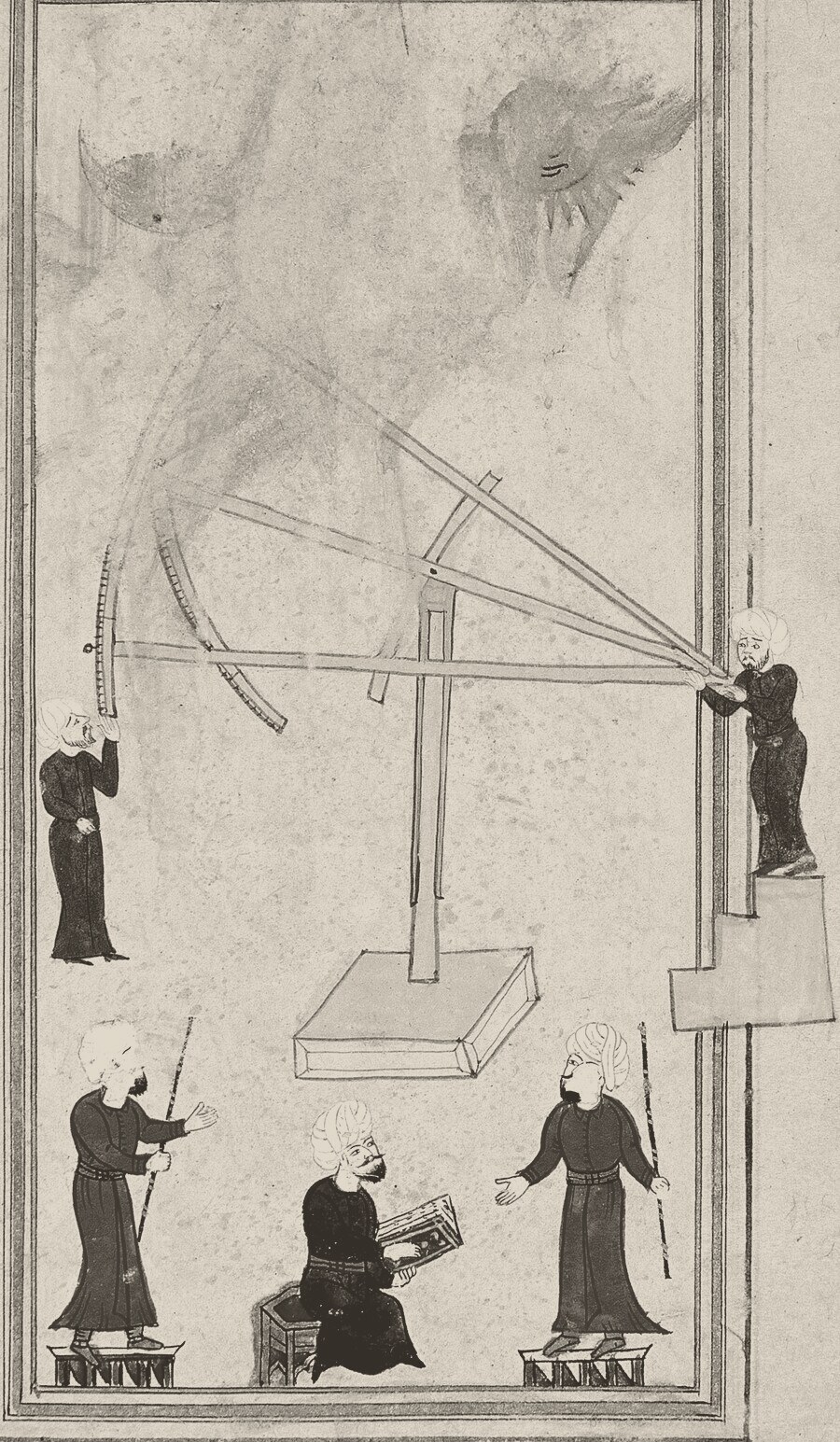
Manuscript painting of a large wooden frame on a square base, with long arms and a curved, graduated arc. One turbaned man sights along an arm from a step at the right, another stands by the arc at the left, and three men stand and sit below, one reading from a book. A sun and a crescent moon are faintly drawn in the sky.
The observatory's frame for measuring the distance between two stars, from the Ālāt-ı rasadiyye, a court text on its instruments, late 16th century. Topkapı Palace Museum Library, Hazine 452, fol. 14b. Photo: Anonymous Ottoman artist, public domain, cropped and toned, via Wikimedia Commons.

The ninth instrument was the clock. A text on the observatory's instruments recalls Ptolemy's complaint that he could have worked with great regularity if only he could measure time precisely, and says that Taqi al-Din, building his clock, did what Ptolemy had failed to do.

A minute cut into five

Taqi al-Din describes the clock in his main astronomical work, Sidrat muntaha al-afkar. In Tekeli's translation he writes: "We constructed a mechanical clock with three dials which shows the hours, the degrees and the minutes. We divided each minute into five seconds." Other historians render the dials as hours, minutes and seconds. On the plain reading of that sentence, the finest mark on his clock was a fifth of a minute: twelve of our seconds.

Drawing, not his clock. One reading of his words: hours, minutes and fifths of a minute. Tekeli's translation names the dials hours, degrees and minutes; how the clock looked is not known in this detail.

Not every reading agrees on the detail. The historian Yavuz Unat describes a minute dial divided into 360 marks ten seconds apart, read to about five seconds. His clock book also speaks of the "degrees" of the day, time counted as the turning of the sky, which is why a dial of degrees appears at all. What the readings share is a clock built to count below the minute.

Why would an astronomer need that? The sky appears to turn once a day, fifteen degrees every hour. Note the moment a star crosses the meridian, and the time since the Sun crossed it tells you how far apart the two lie around the sky, and so, once the Sun's own place is known, the star's right ascension, the sky's version of longitude. Turning time into angle like this needs a clock you can trust. A whole minute of time is a quarter of a degree of sky; one of his fifths is three minutes of arc.

Did it time the stars?

Many accounts say Taqi al-Din used the clock to measure the right ascensions of stars, and he is generally credited as the first astronomer to use a mechanical clock in his observations. The observations of his that specialists have checked tell a more careful story.

His solar work was strong: his value for the yearly motion of the Sun's apogee, the point where it seems farthest from Earth, was 63 seconds of arc, against about 61 today. But in 2015 the historians S. Mohammad Mozaffari and John Steele found that the times he recorded for three lunar eclipses in 1576 and 1577 were all wrong in the same direction, by between 39 and 53 minutes. In 2024 Mozaffari suggested this was seemingly owing to a deficiency in his new mechanical clock, a question that still awaits further study.

Europe was working on the same problem at the same moment. Tycho Brahe described clocks at his observatory that gave single minutes and seconds, and in 1586 Landgrave Wilhelm IV of Hesse-Kassel wrote to Tycho that star positions had been observed with Jost Bürgi's clocks, which showed minutes and seconds, so steadily that between two crossings of the meridian they strayed by less than a minute. That story belongs to a later stop on this tour, Kassel.

A comet over the Bosphorus

In November 1577 a great comet appeared over Istanbul. It was seen from Peru to Japan, and astronomers now call it C/1577 V1. Murad III, about to open a war against Safavid Persia, demanded to know what it meant. By one account Taqi al-Din worked day and night without food or rest, and then brought the sultan "joyful tidings for you concerning the conquest of Persia".

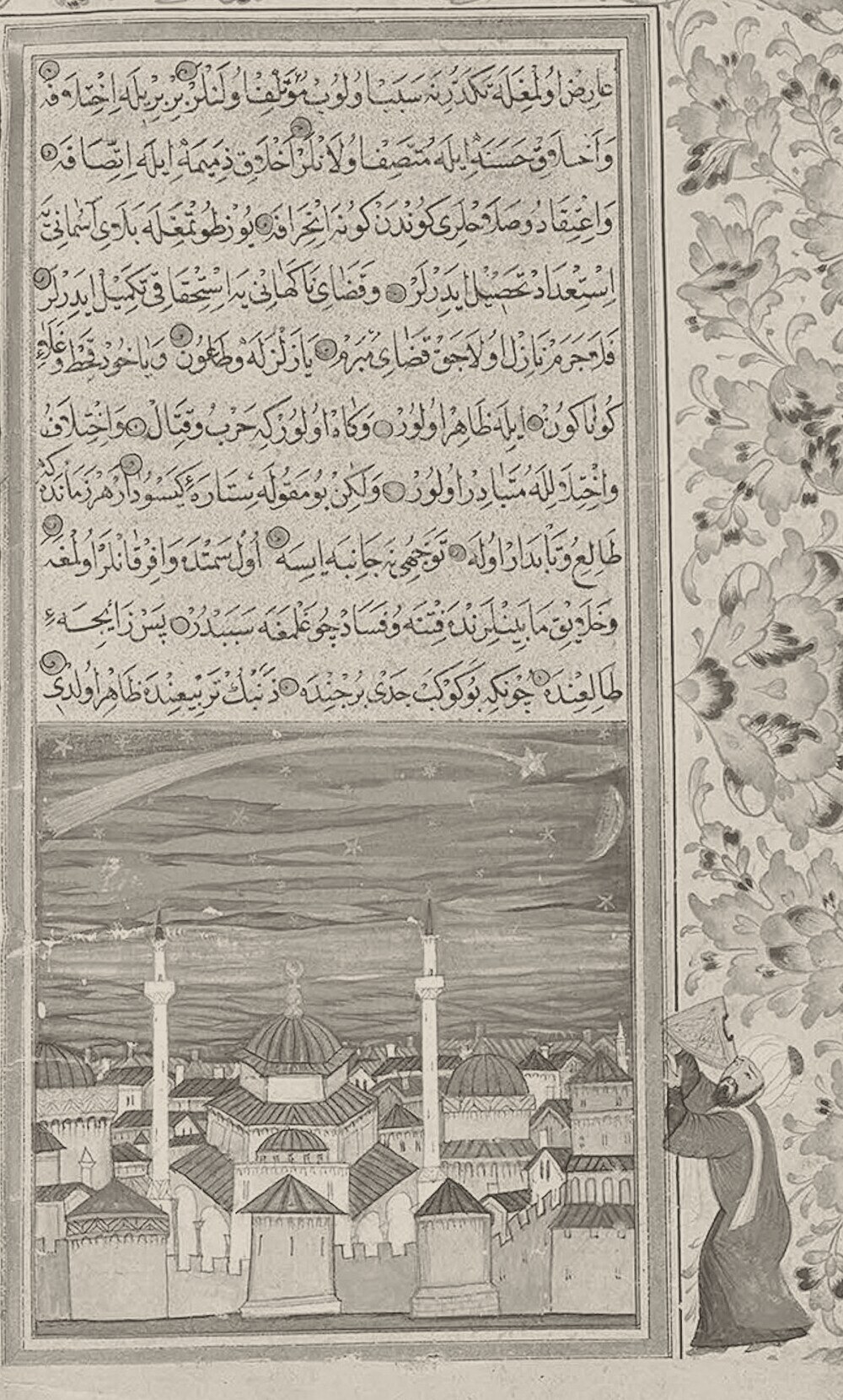
A manuscript page: ten lines of Ottoman Turkish script above a small painting of a walled city with domes and two minarets under a starry night sky, crossed by a long comet. In the floral right margin a turbaned man holds an instrument up to his eye.
The comet of 1577 over Istanbul, with an astronomer sighting it from the margin. From Gelibolulu Mustafa Âli's Nusretname, 1584, Topkapı Palace Museum Library, H.1365, fol. 6b. Photo: Anonymous Ottoman artist, public domain, cropped and toned, via Wikimedia Commons.

Far to the north, on Hven, Tycho Brahe first saw the comet on 13 November. Comparing his measurements with those made in Prague, he found no measurable parallax, the small shift in position you would expect for an object close to the Earth, and concluded that the comet lay beyond the Moon, not in the air as Aristotle had taught. Two of the best-equipped astronomers of the age watched the same comet in the same weeks.

The order of January 1580

The omen did not age well. The war with Persia, which began in 1578, brought victories but also reverses; plague struck the city in 1578; and in October 1579 the grand vizier Sokollu Mehmed Pasha, one of the observatory's backers, was assassinated. According to the chronicler Nev'izade Atai, the chief mufti, Şeyhülislam Kadızade Ahmed Şemseddin Efendi, warned the sultan that prying into the heavens was ill-omened: in no kingdom where such observations were begun had ruin not followed.

On 22 January 1580 Murad III sent an order to his grand admiral, Kılıç Ali Pasha, to pull the observatory down, and it was destroyed together with its instruments. One chronicler puts the demolition a couple of months later. The observatory had worked for about three years. Taqi al-Din stayed in Istanbul and died there in 1585.

Why it came down, the sources don't settle: a religious ruling, or court politics and a hostile report to the sultan.

Why it happened, historians weigh differently. Older accounts saw religion defeating science. Salim Aydüz reads the mufti's hostility as aimed less at Taqi al-Din than at his patron Hoca Sadeddin. İhsan Fazlıoğlu points to politics and to Taqi al-Din's own wrong prognostications. Baki Tezcan sees a sultan claiming new authority over knowledge and jurists defending theirs, so that the mufti's reaction was "a political response, and not an instance of religious fanaticism"; and he is careful to add, "if he really wrote what Ata'i claims he did". Some Turkish writers doubt the letter altogether.

The newest voice is A. Tunç Şen of Columbia University, whose 2025 book Forgotten Experts studies the Ottoman court astrologers. He has found no sign that Ottoman writers of the next three centuries mourned the observatory; it may first have been cast as a great loss in the 1920s, by the astronomer Fatin Gökmen. He is wary both of reading its fall as the start of a decline and of celebrating its building as a triumph.

From fifths of a minute to fifths of a second

Taqi al-Din's clock did not survive. Its idea did. A classic mechanical watch has a balance that makes five vibrations a second, 18,000 an hour, so its seconds hand moves on in five small ticks every second. Where Taqi al-Din cut a minute into fifths, a watch like that cuts each second into fifths.

He was not alone in wanting finer time, and far steadier clocks came later, with the pendulum and the balance spring. But the instinct behind his three dials, that timing anything precisely means dividing the hour into ever smaller, steady pieces, is the same instinct behind the seconds hand still sweeping across a watch face today.

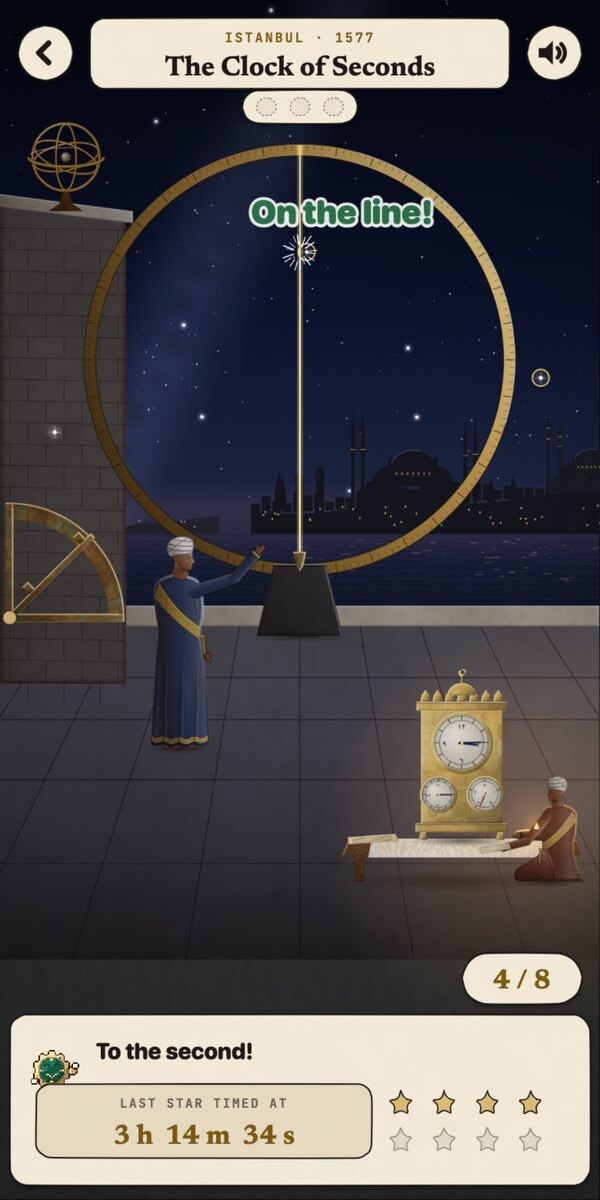
A frame from the WORN chapter The Clock of Seconds: at night on the observatory terrace, a star touches a cord hung inside a great brass ring and is ringed in gold; below, the three-dial clock sits on a table, and a card reads the time the last star was timed, in hours, minutes and seconds.

A frame from The Clock of Seconds, chapter 51 of the Grand Tour of Time in WORN.

Chapter 51 · The Clock of Seconds

Tick, the guide, asks: Taqī al-Dīn built a clock with hours, minutes and seconds for his new observatory. Why did an astronomer need seconds?

Play this chapter in WORN Get WORN on the App Store

Sources

  • S. Tekeli, "The Instruments of Istanbul Observatory" (1980; Muslim Heritage, 2008)
  • S. Aydüz, "Taqi al-Din Ibn Ma'ruf: A Bio-Bibliographical Essay" (Muslim Heritage, 2008) and "Osmanlı Astronomi Müesseseleri" (TALİD, 2004)
  • İ. Fazlıoğlu, "Taqī al-Dīn", Biographical Encyclopedia of Astronomers (2007)
  • S. Al-Hassani, "The Astronomical Clock of Taqi al-Din: Virtual Reconstruction" (Muslim Heritage, 2008)
  • B. Tezcan, "Some Thoughts on the Politics of Early Modern Ottoman Science", Osmanlı Araştırmaları (2010)
  • Y. Unat, "Development of Astronomy in Ottomans" (Muslim Heritage, 2019)
  • H. G. Topdemir, "Takıyyüddin er-Râsıd", TDV İslâm Ansiklopedisi
  • S. M. Mozaffari and J. Steele, Archive for History of Exact Sciences (2015); S. M. Mozaffari, same journal (2024)
  • A. T. Şen, interview on Forgotten Experts, JHI Blog (2026)
  • A. E. Tozoglu, Urban History (2026)
  • Neuhäuser et al. (2016); High Altitude Observatory, "Tycho Brahe"
  • P. Lunde and Z. Bilkadi, "Arabs and Astronomy", Aramco World (1986)
  • Fondation de la Haute Horlogerie, "Vibration"
  • Wikipedia: "Constantinople observatory of Taqi ad-Din", "Great Comet of 1577", "Sokollu Mehmed Pasha"

Dive deeper

  1. EssayThe Instruments of Istanbul Observatory · Sevim Tekeli, Muslim Heritage, 2008.The historian who edited the sources, instrument by instrument, set beside Tycho Brahe's. First given as a paper in 1977.
  2. EssayThe Astronomical Clock of Taqi al-Din: Virtual Reconstruction · Salim Al-Hassani, Muslim Heritage, 2008.A walk through his 1559 clock book, gear by gear, with a modern reconstruction.
  3. EssayDevelopment of Astronomy in Ottomans · Yavuz Unat, Muslim Heritage, 2019.The observatory, its instruments, the comet and the demolition, with a different reading of the clock's dials.
  4. PaperSome Thoughts on the Politics of Early Modern Ottoman Science · Baki Tezcan, Osmanlı Araştırmaları 36, 2010.Why the observatory's rise and fall was about politics, not religion against science. Free to read.
  5. PaperSolar and lunar observations at Istanbul in the 1570s · S. Mohammad Mozaffari and John M. Steele, Archive for History of Exact Sciences, 2015.How accurate his observations really were, checked against modern data. Paywalled; the abstract is free.
  6. PaperBetween fear and fascination: spatial manifestations of Habsburg-Ottoman rivalry in early modern Istanbul (c. 1530 to 1606) · Ahmet Erdem Tozoglu, Urban History, 2026.Embassies, gifts and the clocks that crossed between Vienna and Istanbul. Open access.
  7. EssayConstructing Expertise in the Ottoman Empire: An Interview with A. Tunç Şen · Furkan Elmas, JHI Blog, 2026.The newest historian of Ottoman court astrologers on the observatory and the myths around its fall.
  8. BookForgotten Experts: Astrologers, Science, and Authority in the Ottoman Empire, 1450 to 1600 · A. Tunç Şen, 2025.The world Taqi al-Din worked in: the munajjims who timed the empire's affairs by the stars.
  9. BookThe Observatory in Islam and Its Place in the General History of the Observatory · Aydın Sayılı, 1960.The classic study of Islamic observatories, Istanbul included. Still the starting point, to be read with newer work.
  10. On this tourKassel, Nuremberg, The HagueSeconds at the Kassel observatory, the spring-driven watches he wrote about, and the pendulum that finally made clocks steady.